
Fiberon PETG-rCF08 review: a cleaner matte part without a strength shortcut
At a glance
A useful matte, stiff PETG option; drying, feeder compatibility and realistic load expectations still matter.
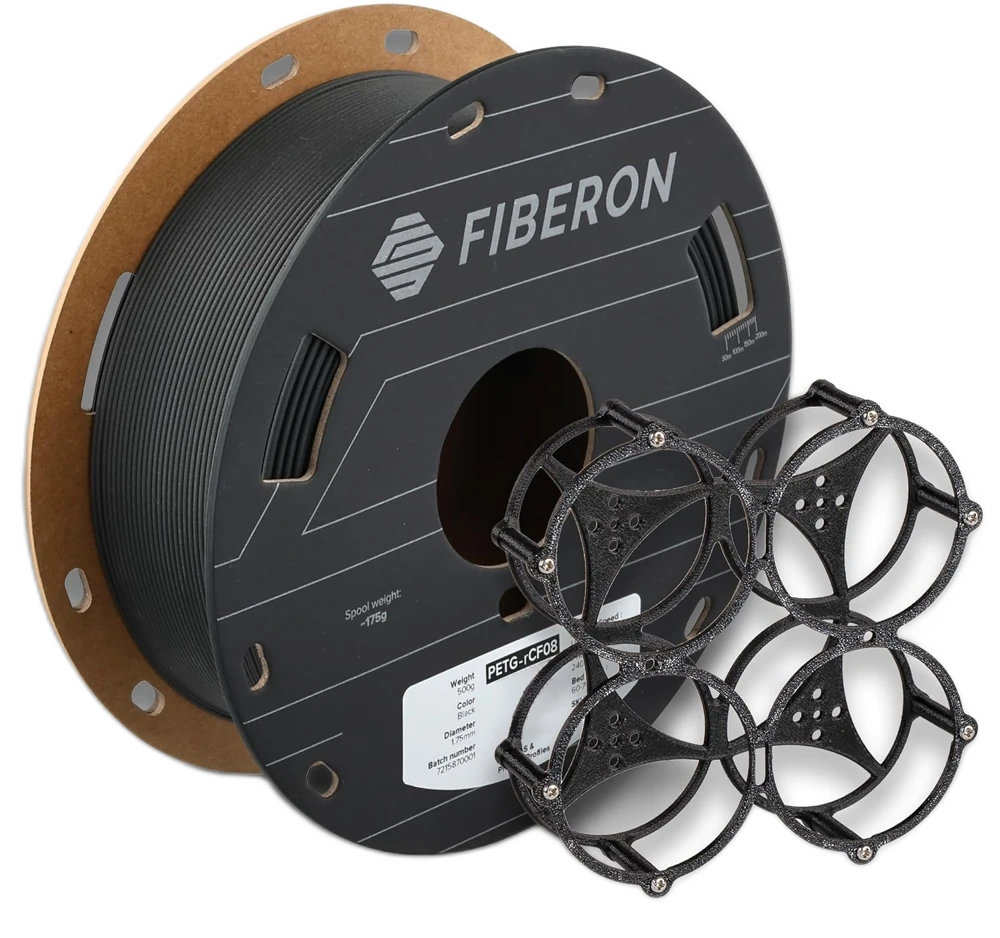
The material & format
- PETG with 8% recycled carbon fiber
- Selected black, 1.75 mm, 0.5 kg spool
- Confirm abrasive-material hardware and current care guidance
Why consider it
- A matte finish with less conspicuous general layering.
- Stiffer-feeling parts in familiar PETG workflows.
What to weigh up
- Feeder success does not override compatibility guidance.
- Some rolls needed drying and flow adjustment.
- A strong-looking part may still be unsuitable for a heavy load.
PETG-rCF08 is most useful when you want a matte functional prototype with more stiffness than your familiar unfilled material. The favorable feedback is particularly strong on appearance and clean extrusion. It is less useful as proof of an unrestricted strength upgrade.
Choose the requirement you can actually check
| Buying reason | Useful trial |
|---|---|
| Less nozzle buildup | Repeat a known troublesome geometry after material preparation. |
| Matte exposed surface | Inspect the seam as well as the broad walls. |
| A functional gear or fixture | Check the intended load and wear conditions separately. |
The official formulation uses 8% recycled carbon fiber. That describes the reinforcement, not a measured improvement for your part. One matched account found lightly loaded gears satisfactory while remaining unconvinced about greater stress.
Do not use a feeder anecdote as approval
Several accounts report successful automatic feeding, but one explicitly acknowledges using a feeder outside its recommendation. Verify the current equipment guidance and prepare appropriate abrasive-resistant hardware.
Pros & Cons Analysis
Based on supplied customer reviews and verified product documentation
Pros
- Appearance and cleaner extrusion are useful benefits. Matching accounts describe less nozzle buildup and attractive functional parts. These do not mean every seam becomes invisible.
- A plausible entry into reinforced materials. Successful accounts include prepared desktop printers and prototype components. The benefit should be judged on the actual design rather than an assumed strength percentage.
Cons
- Brittle and abrasive feedstock changes the decision. A favorable account knowingly used a feeder outside its recommendation. Do not turn that outcome into general approval.
- The first print is still a qualification step. A prototype workflow resolved under-extrusion after preparation and tuning. This coexists with good direct-from-package accounts.
- Keep the gear experience in perspective. One account found it adequate for lightly loaded gears but less strong than expected. Neither that impression nor glowing feedback establishes a load rating.
Choose for the finish, qualify the mechanism
Try PETG-rCF08 for matte functional prototypes when the hardware is suitable. Keep seam quality, feeding and the actual service load as separate checks before repeating the part.
Frequently Asked Questions
Does the rCF08 name mean the whole PETG spool is recycled?
No. It identifies the 8% recycled-carbon-fiber formulation, not a claim that the entire material or package is recycled.
Can a tidy matte surface hide a weak seam?
Yes. Surface appearance does not establish layer or seam strength. Include the relevant joint and load direction in a representative PETG-rCF08 trial.
Technical Specifications
| Product type | Reinforced PETG filament |
|---|---|
| Reviewed formulation | PETG with 8% recycled carbon fiber |
| Nominal filament diameter | 1.75 mm |
| Manufacturer diameter tolerance | Not verified for this exact formulation |
| Package format | 0.5 kg spool |
| Nozzle guidance | Manufacturer starting range: 240–270°C nozzle; 60–70°C bed. Match the printer and build surface. Hardened nozzle required; confirm the filament’s minimum orifice. |
| Material care | Manufacturer drying guidance: 65°C for 3 hours; verify the supplied spool tolerates the cycle, then store dry. |
| Variant / handling limit | Not interchangeable with other Fiberon PET/PETG grades |

Polymaker PETG

Bambu Lab PETG HF

Prusament PETG
Bambu Lab PETG Basic