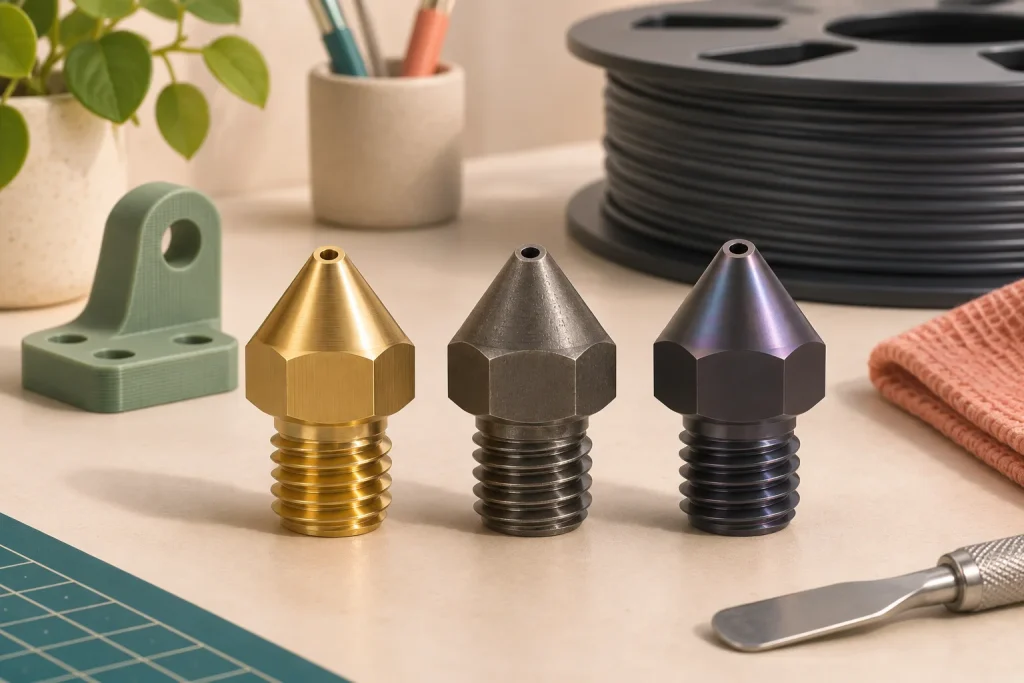
For carbon-fiber-filled filament, choose an abrasion-resistant nozzle approved for the exact material and compatible with your hotend. Then check its orifice diameter. Wear resistance, particle clearance and physical fit are separate requirements; passing one does not settle the others.
Build a nozzle specification before choosing a brand
| Requirement | What to write down | Why it changes the choice |
|---|---|---|
| Filament | Full product name, base polymer and filler. | PLA-CF, PETG-CF and nylon-CF need not share a profile. |
| Wear resistance | The nozzle maker’s approved material classes. | A larger brass opening does not solve abrasive wear. |
| Diameter | The filament supplier’s minimum or recommended orifice. | A wear-resistant tip can still be too small for the material. |
| Fit | Hotend family, nozzle version and supported printer. | Similar-looking parts are not necessarily interchangeable. |
| Operating limits | Supported temperature and matching slicer profile. | The entire hotend must suit the polymer, not just its tip. |
Prusa’s fiber-filled material guidance requires hardened nozzles because the fillers are abrasive. It also treats first-layer height and nozzle opening as clogging considerations. Do not read a carbon-fiber label as a guarantee of universally stronger parts; the same source describes tradeoffs in layer bonding and impact behavior.
Is 0.6 mm mandatory?
No single diameter covers every composite. Prusa’s general fiber-filled guide discusses 0.4 mm as a lower starting point in its recommendations, while individual materials can call for a different opening. The actionable number is the one in the exact filament instructions. If those instructions require 0.6 mm, buying a hardened 0.4 mm nozzle does not meet them.
Once the required size is known, reslice the model for it. Keep a fine-feature requirement visible in the decision: if the supported nozzle cannot resolve an essential feature, reconsider the material or model rather than ignoring the supplier’s minimum.
Turn the requirements into a compatible shortlist
After identifying the hotend and minimum orifice, use the abrasive-nozzle shortlist. It separates Revo ObXidian from FlowTech CM2 and keeps standard-flow and high-flow options distinct; the two interfaces are not substitutes.
For PA composites, check the exact nylon formulation and the required drying equipment at the same time. A compatible nozzle does not make an unsupported drying cycle adequate.
A coated nozzle still has a service life
E3D’s Revo ObXidian support page lists compatible Revo systems and warns that aggressive fillers can cause wear even on its abrasion-resistant coating. A premium material or coating therefore does not establish an unlimited lifespan. Inspect and maintain the nozzle by its own instructions; do not invent a kilogram-based replacement interval.
The same support page separates recommended and discouraged cleaning methods. That matters when changing nozzle construction: a method familiar from another hotend should not automatically follow the upgrade. Use the manufacturer’s installation procedure as well; this guide does not substitute a universal tightening temperature or torque.
Turn “carbon-fiber capable” into a matched setup
Buy only after the filament, nozzle and hotend documents agree. An abrasion-resistant tip is the beginning of that check.
Keep these four answers together.
The nozzle supports the exact filler class.
Its diameter meets the filament requirement.
Its connection and operating range match the installed hotend.
A matching sliced profile and installation procedure are available.
Prepare the material using its own instructions and the drying setup workflow. Check build-surface compatibility separately; a nozzle upgrade does not establish plate suitability.
One specification is still missing
Pause the purchase and obtain that exact compatibility detail. A premium coating does not resolve an unknown connection or unsupported diameter.