
SUNLU SP2 review: buy for the reel dimensions, not the 3 kg label
At a glance
A removable drying-and-storage box for compatible large reels, with physical spool clearance and fan noise worth checking.
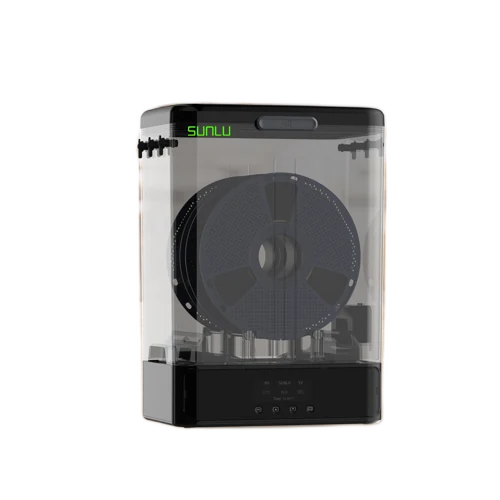
The setup
- Removable chamber and separate heater base.
- Large-reel accommodation within stated dimensions.
- Temperature and timer control.
- Sealable box with independent humidity display.
Why consider it
- Accommodates suitable large reels and two standard rolls.
- The same box can move from drying to storage.
- Successful direct feeding reduces spool transfers.
- Useful print improvements with compatible materials.
What to weigh up
- Some 2.5–3 kg reels rub or do not fit.
- Lid catches and loaded support rod can be awkward.
- Tube movement and feed drag need attention.
- Fan sound and display placement can limit positioning.
The SUNLU SP2 makes its strongest case when an ordinary one-kilogram dryer is too small, but a large shared chamber is more equipment than you need. Its removable box can hold a suitable large reel, stay around that reel after drying, and feed the printer without another transfer. The important word is suitable: buying by spool weight alone is the easiest way to be disappointed.
Check the package before the capacity. This review concerns the SP2 heating base plus storage box. The separate storage-box offer does not include the heater. Extra boxes expand your storage; they do not add simultaneous powered drying capacity.
A 3 kg label does not settle whether your reel fits
Successful use with SUNLU three-kilogram rolls is a recurring strength. Larger rolls can stay in their own container instead of needing to be moved into a different bag or enclosure after preparation. Two ordinary one-kilogram rolls also make practical use of the chamber when they need the same drying treatment. Check the shared-cycle requirements before filling the second position with a different material.
But capacity and free rotation are different checks. Feedback includes Siraya Tech 2.5 kg reels that enter the box but rub the walls, and large PET-CF reels that create too much resistance for printing. A heavy reel does not have a standardized shape. A lighter, wider reel can be a worse fit than a heavier, narrower one.
| Check before buying | Why it changes the decision |
|---|---|
| Outside diameter and total width | Compare actual flange dimensions with the documented limit, not only the weight printed on the label. |
| Rotation and side clearance | A reel that can be placed inside may still rub when the printer pulls filament. |
| Route to the extruder | Allow a gentle path that does not pull the reel against a wall or draw the tube into the box. |
| Material instructions | The dryer’s highest setting must suit the exact filament and its spool. |
SUNLU specifies a maximum spool envelope of 250 mm diameter by 153 mm width. Treat that as the first screening step, then confirm usable clearance for the actual reel. Do not buy an awkwardly fitting spool on the assumption that a printed adapter will make it work: modifications described in customer feedback are not a documented fit guarantee.
The removable box is useful after the heater stops
The distinctive benefit is keeping the same spool contained across drying, storage and use. Successful setups leave large PETG rolls in their boxes and switch another box onto the base. That saves repeated handling, especially when an opened large reel would otherwise need its own storage solution.
Positive sealing reports support the idea, including storage that remained stable over a week in one setup. That is encouraging practical feedback, not a maintenance-free storage promise. Seals, plugs, desiccant condition and room humidity still matter. The removable box has to be configured correctly for drying and then for storage; leaving it permanently in one configuration misses the point of the design.
Switch from drying to storage deliberately
The SP2 manual calls for an open filament outlet during drying so moisture can escape. For storage, remove the chamber from the base, fit the bottom airlocks and close the outlets with their stoppers. After the power-button shutdown, the fan runs for three more minutes; that cooldown is normal.
- One large active reel: drying, storage and feeding can share a container.
- Several reels in rotation: extra boxes may be useful if their cost and space fit your collection.
- Several reels needing heat at once: additional boxes alone do not solve the queue.
Better prints are more useful evidence than a low humidity number
Observed printing improvement
Improved printing with PLA, PETG and TPU appears in the feedback, including less moisture-related trouble with previously exposed material. The SP2 also earns praise for quick heating and convenient repeat use. Those observations make it a plausible preparation tool for compatible materials; they do not establish a measured drying rate or make every print defect a moisture problem.
Match the material cycle
The documented range is 35–70°C with a timer up to 99 hours. A preset saves input, but the filament maker’s instructions should determine the treatment. Reports of success with particular engineering materials do not establish suitability for every nylon, PC or fiber-filled formulation. One account describes good PC results but an unsuccessful attempt with a different blend even after a long cycle.
What the hygrometer measures
The separate hygrometer helps monitor the box environment. It cannot tell you the water content inside the filament. A falling air reading is therefore not a reason to end a material’s specified drying cycle early, nor does it prove that a difficult spool is ready.
Check the power version: the manual lists separate 110 V/60 Hz and 220 V/50 Hz inputs. Choose the version and plug intended for your local supply; do not assume the unit accepts both voltages.
Where the daily handling feels less polished
Lid clips and the loaded support rod
The lid can seal firmly, yet its sliding catches can drift into the wrong position while you replace it. Seating the support rod with a loaded reel is another reported frustration. These are small interactions, but they matter more when you change spools frequently than when one large roll stays installed for days.
Two displays, two viewing directions
The heater controls and the box hygrometer are not conveniently visible from the same position in every setup. Consider which side faces you before committing a shelf location. Repeatedly leaning around a printer to inspect the box takes away some of the convenience of leaving the reel contained.
Feeding may need more attention than drying
Smooth direct-feeding experiences coexist with tube movement and spool drag. The supported spool dimensions alone cannot settle that difference. Test the complete route before relying on it for a long job, and follow the supplied routing instructions. Do not force a reel that rubs or use the printer’s pull to overcome a poor fit.
The fan is noticeable in some rooms
Noise feedback is mixed: comfortable shared-office use appears alongside complaints of a prominent fan or higher-pitched sound. That does not support calling the SP2 silent, or assigning it a sound level from anecdotes. If it will sit beside your desk, judge a complete operating cycle during the return period.
There is also a reported fan failure after several months, a damaged hygrometer display, and an unanswered support request. Those reports do not establish how often faults occur, but they are reasons to inspect the delivered unit and confirm the seller’s support route. A stopped fan or unreliable control is a service issue, not a reason to keep running the heater or copy a repair from a review.
Choose around the reel, then the routine
The SP2 is compelling when a verified large reel and a removable storage box solve two problems together. It is less convincing when you only need occasional treatment for one standard spool, or when the reel you actually use has uncertain clearance. In the latter case, a larger number on the capacity label is no substitute for an exact fit check.
Pros & Cons Analysis
Based on supplied customer reviews and verified product documentation
Pros
- Large-roll preparation without committing to a much larger station. Successful three-kilogram SUNLU use is a concrete reason to choose SP2. It solves a capacity gap for matching reels, but a nominal weight is not a dimensional standard.
- Storage can stay with the spool. Separate boxes let prepared stock remain contained while the base treats another roll. This is particularly useful for opened large reels; inspect seals and desiccant rather than assuming a sealed box eliminates maintenance.
- Preparation and feeding can share a container. Working print-through arrangements save handling and avoid finding a separate large-reel holder. That convenience depends on adequate side clearance and a stable tube route.
- The heater has a useful role beyond a low air reading. Better PLA, PETG and TPU output supports using it for the specified treatment of compatible material. The evidence does not establish a drying speed or validate every engineering formulation mentioned in the review pool.
Cons
- Entering the box is not the same as rotating freely. Siraya Tech 2.5 kg and other large-reel accounts describe wall contact and excessive drag. Measure the actual flanges and verify working clearance; do not buy on the assumption that an improvised adapter will fix the problem.
- Frequent changes expose small handling frustrations. Sliding lid catches can move while the cover is replaced, and a loaded support rod can be fiddly to seat. These compromises matter less for a long-lived active reel than for constant swapping.
- The route can undermine a good drying result. Tube movement and reel drag occur alongside successful feeding. Qualify the complete path before a long job, and stop if the printer is pulling against resistance.
- Bench placement needs more thought than the footprint suggests. The hygrometer and heater display may face different useful viewing directions, while fan impressions range from unobtrusive to intrusive. A shared office deserves an operating-cycle check rather than a silence assumption.
The right purchase starts with a measured reel
SP2 earns its space when a verified large reel can remain boxed from preparation through printing. The removable chamber is the reason to choose it; uncertain clearance is the reason to wait.
My large reel has confirmed clearance
The combined drying and storage routine is a strong fit. Check the complete base-and-box offer, then qualify the feed route before a long job.
My reel fits tightly or its dimensions are unknown
Resolve that first. A cheaper purchase is not useful if the reel rubs the walls and cannot feed.
I only need ordinary one-spool drying
Compare a smaller dryer around your material requirements. The removable large box may add little to that routine.
Frequently Asked Questions
Does the separate storage box dry filament on its own?
No. Active drying requires the heating base. A box-only offer expands storage, not powered drying capacity.
Will any 3 kg reel fit?
No. Check flange diameter, width and free rotation. Some large reels enter the box but rub enough to prevent reliable feeding.
Can several boxes dry at once on one base?
Additional boxes should be treated as storage capacity. Do not assume a stack of boxes creates extra simultaneous drying chambers.
Can the hygrometer tell me when a spool is dry?
It monitors chamber air. Follow the filament’s specified treatment rather than treating a low reading as a measurement of water inside the material.
Technical Specifications
| Product type | Standalone filament dryer |
|---|---|
| Reviewed configuration | SP2 heating base + storage box; separate box-only offer is not a complete dryer |
| Drying capacity | Two 1 kg rolls or one compatible 2–3 kg roll; physical dimensions govern |
| Heat control | 35–70°C; 0–99 h; 250 W maximum working power |
| Printing from the dryer | Six outlets; confirm side clearance and tube retention for the exact reel |
| Humidity behavior | Separate hygrometer and desiccant compartment; sealed storage configuration |
| Fit and measurement basis | Maximum spool envelope 250 mm diameter × 153 mm width; enclosure 278 × 208 × 396 mm |
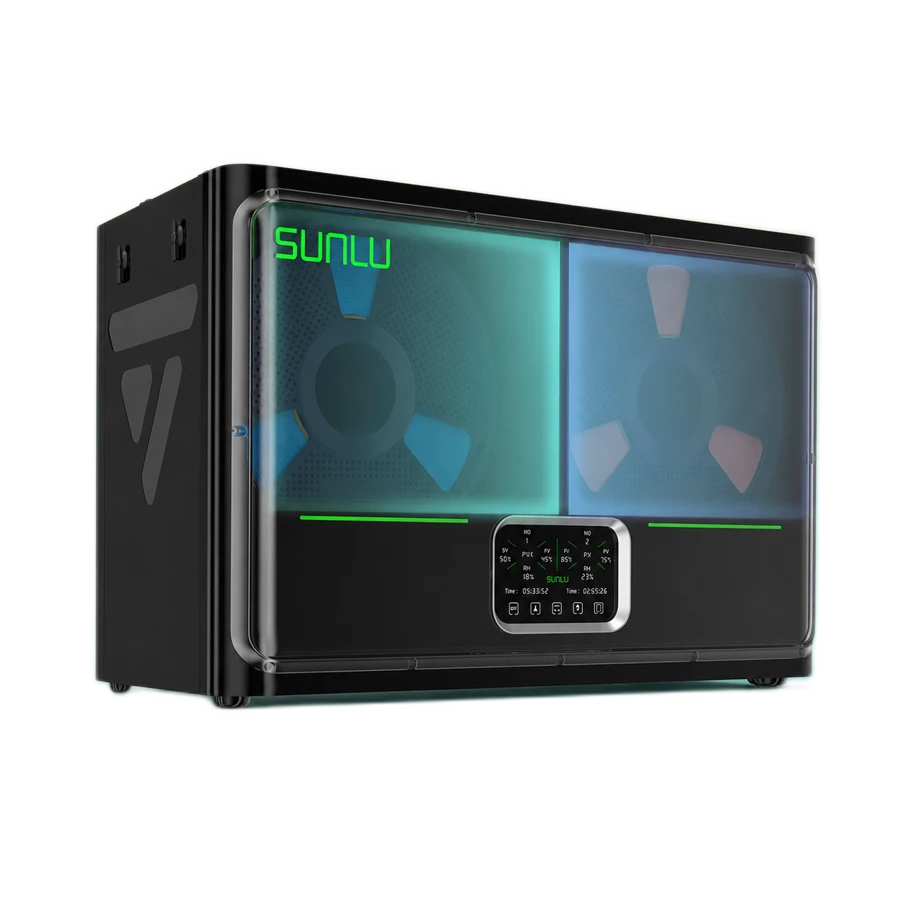
SUNLU FilaDryer S4 Pro

Creality Dry Box 2.0
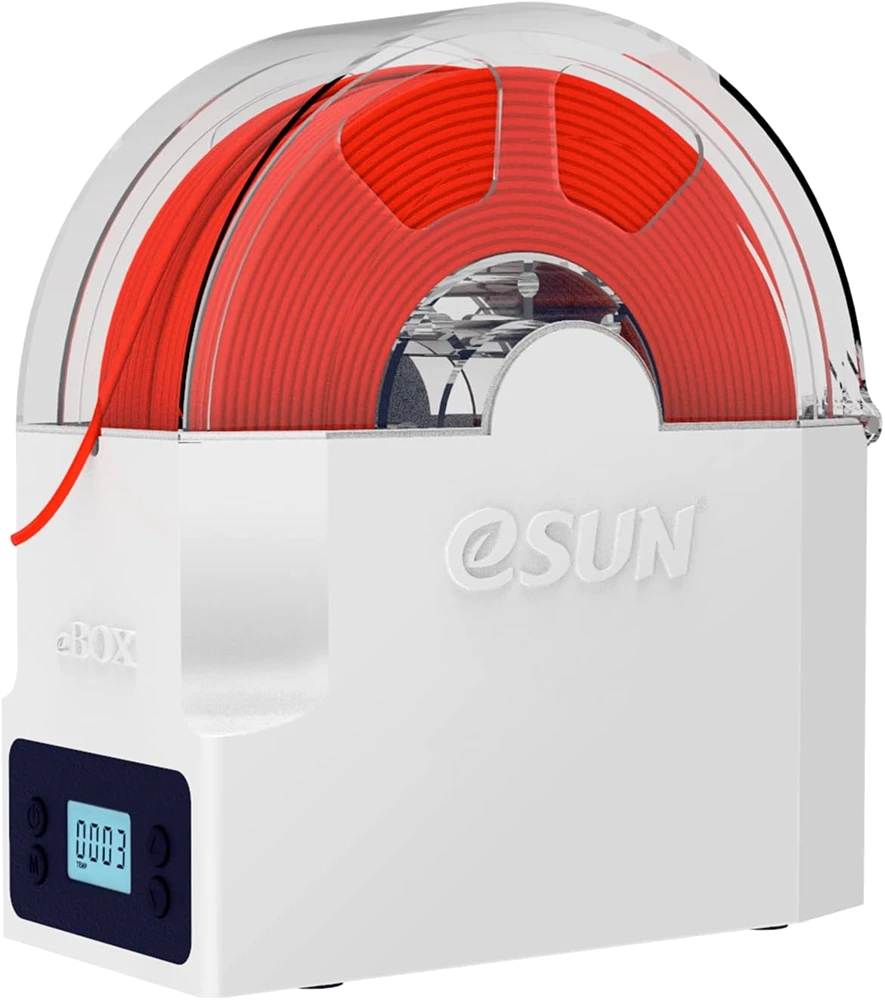
eSUN eBOX Lite
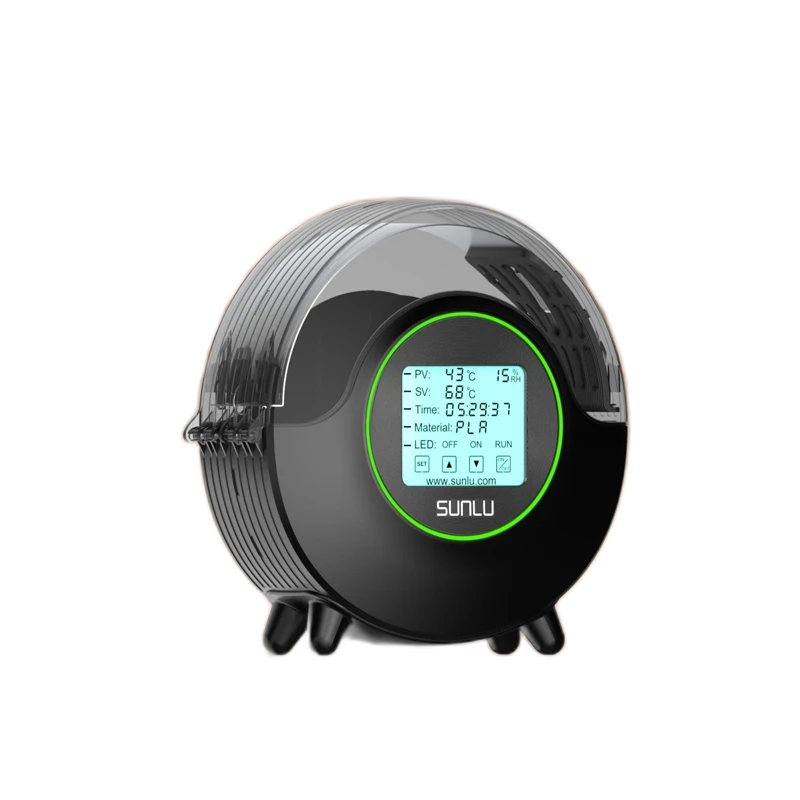
SUNLU FilaDryer S2