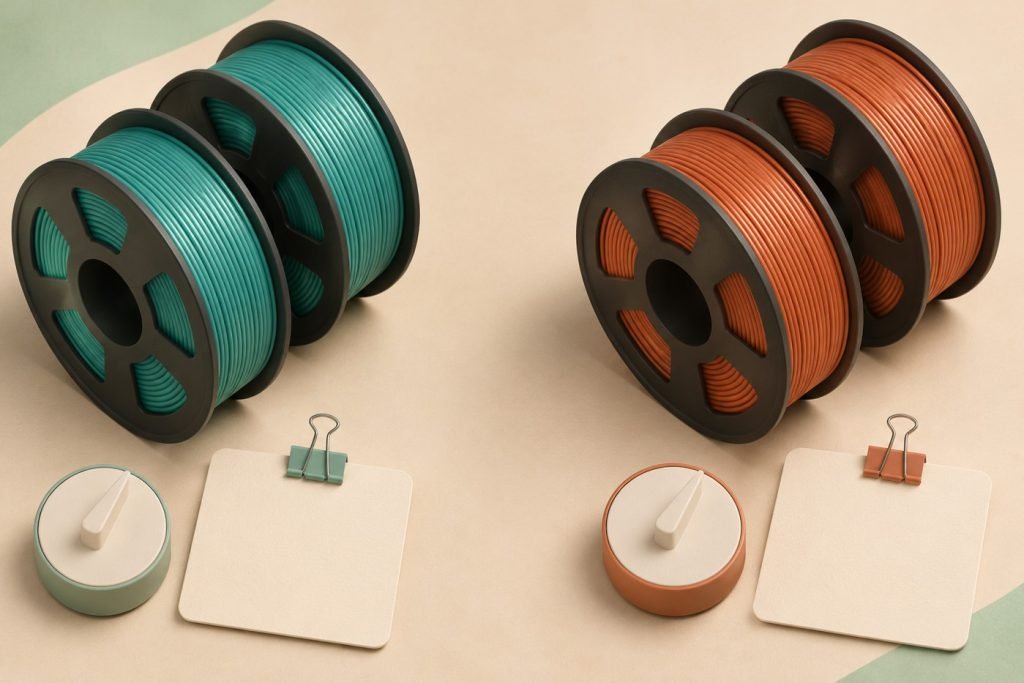
You can share a drying session only when the exact filaments, their spools and the dryer support a compatible program. Four available spool spaces do not mean four materials can use four different temperatures. Start by grouping the rolls by their documented requirements, then choose the chamber or schedule.
Make a program match before a space-saving decision
Prusa’s drying guidance gives different temperature/time combinations for its materials and warns against exceeding the recommendations. For example, its Prusament PLA and PETG entries use different temperatures. Those are brand-specific instructions, not a universal chart for every formulation carrying the same polymer name.
Putting both rolls at an averaged temperature does not establish an effective program for either. Use a shared setting only when the documentation supports it for every loaded material; otherwise separate the sessions or use genuinely independent chambers.
| For each roll | Write down |
|---|---|
| Material | Exact formulation and its drying instructions. |
| Spool | Its temperature limit and any documented preparation. |
| Program | Supported temperature, duration and operating mode. |
| Deadline | When the prepared roll will actually be needed. |
Count controlled chambers, not just reels
A shared heated space has one environment for its contents. Independently controlled chambers can accommodate separate programs, within the machine’s documented limits. Creality explicitly describes the SpacePi X4 as having dual independent heating chambers. That is a specific feature to verify on the exact model, not a capability implied by every four-spool dryer.
Before buying, check what is independent: temperature, timer, chamber selection and any storage mode. A pair of lids or several filament outlets does not by itself answer those questions. The useful capacity is the number of compatible rolls you can prepare in time for the job.
One compatible group
Use the supported shared program and check that all rolls fit the permitted loading arrangement. Leave the airflow and outlets arranged as the manual requires.
Different program requirements
Assign separate controlled chambers if the model supports them, or schedule separate runs. Do not turn an average of two settings into a new drying recipe.
If the purchase decision is between a shared batch and separate chambers, use the SpacePi X4 versus SUNLU S4 comparison. Keep your program groups beside the comparison so nominal spool count does not replace the scheduling requirement.
The reel can be the limiting component
Prusa’s instructions distinguish old and new spool constructions and their preparation requirements. This is a useful reminder to identify the reel as well as the filament. A polymer capable of a hotter drying program may be supplied on a spool that needs different handling. Do not infer the reel’s limit from its color or from the filament name alone.
Use the supplied spool instructions rather than improvising reinforcement or transferring a loose refill merely to fit the hotter batch. If the needed program cannot be used with the available reel and equipment, resolve that compatibility issue before starting.
What if the temperatures match but the times differ?
Check whether both instructions permit the longer exposure and whether the dryer’s documented operation allows the required removal or separate timing. Do not assume the shorter program’s roll can remain indefinitely. When the permitted overlap is unclear, separate runs give you a documented schedule instead of a guess.
Schedule the printer’s next job first
As an organizing example, suppose tomorrow’s print needs two rolls with the same supported program, while another roll with a different requirement will not be used until the weekend. Prepare tomorrow’s pair first. A full chamber is not a benefit if it delays the material you need or forces an incompatible program.
After a completed session, move the prepared rolls into appropriate dry storage according to the material instructions. Use the drying workflow for the individual cycle; this grouping step decides which rolls belong in it.
Your next batch has a simple entry rule
Every roll needs a supported program, a suitable spool and a valid place in the dryer. If any of those is unresolved, leave that roll out of the shared run.
All requirements overlap
Record the common program and load arrangement, then run the documented cycle. Keep each roll identifiable when you return it to storage.
One requirement conflicts
Split the group. Choose separate sessions or independent chambers based on your actual schedule, rather than making the least-compatible roll dictate an improvised compromise.