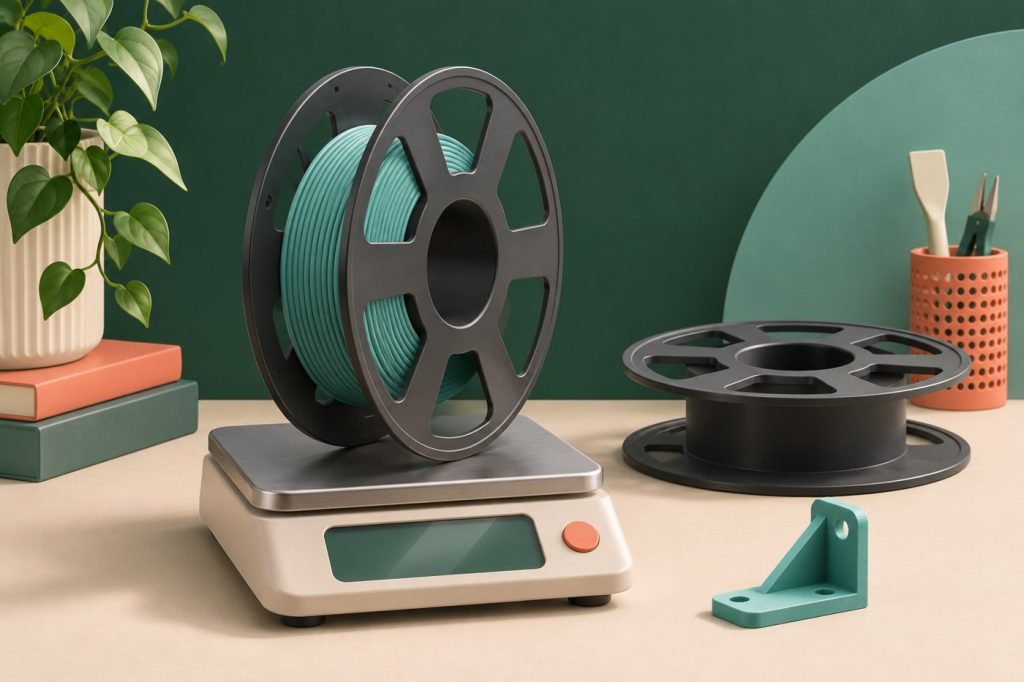
A partly used roll can look sufficient and still run out before the last layer. For a useful check, weigh the loaded reel, subtract the weight of that exact empty reel, then compare the remaining filament with the complete sliced job. The space left between the flanges is only a rough visual clue.
Remaining filament = loaded reel weight − empty reel weight. Use the same units for both. Then allow for uncertainty and material used outside the saved job estimate.
First, make the weighing meaningful
- Secure the loose end before removing the reel. Follow the printer’s unloading procedure and keep the winding contained.
- Weigh the reel by itself. Remove the bag, loose desiccant and removable holder adapters. Keep any item included in your empty-reel reference consistent.
- Identify the empty weight. A record from this reel is best. Otherwise use manufacturer information for the exact spool design, or a matching empty reel with the uncertainty noted.
- Subtract once. The scale reading already includes the reel. A nominal “1 kg” label describes the original filament quantity, not an empty-spool weight to subtract.
Do not borrow a tare value just because the reel has the same brand name. Cardboard, plastic, refillable and revised spools can have different weights. If you cannot identify the reel reliably, record the remaining amount as uncertain rather than producing a precise-looking answer from a guessed tare.
Prusament offers a useful model-specific alternative: its spool detail page has a remaining-length calculator that accepts weight including the spool. Use the lookup for your actual roll; a sample page or another roll’s data is not your inventory.
A 17-gram margin is a question, not a guarantee
| Item | Amount |
|---|---|
| Loaded reel on the scale | 365 g |
| Known empty reel | 200 g |
| Calculated filament remaining | 165 g |
| Complete sliced-job estimate | 148 g |
| Difference before allowances | 17 g |
The subtraction is straightforward: 365 − 200 = 165, then 165 − 148 = 17. The decision depends on how much you trust the inputs. An uncertain reel weight, a changed slice, or extra loading and purging can consume that difference. There is no single percentage reserve that makes every printer and job safe.
What if the empty reel might weigh 20 g more?
With a 220 g reel, the same 365 g scale reading leaves 145 g of filament. That is already 3 g short of the 148 g job. The uncertainty in the tare is more important than the apparent 17 g margin.
Compare against the whole job, one material at a time
Slice the final arrangement with the intended printer and material profile. Check the estimate for all printed objects, supports, brims or rafts, and any purge or wipe structures. Read the slicer’s total rather than adding a component twice. Material consumed during loading or other operations outside that estimate needs its own allowance.
A small multicolor model is not necessarily a small filament job. Prusa’s wipe-tower documentation explains that tower demand depends on color changes rather than just object size. Compare the demand for each material with its own remaining roll; an abundant second color cannot make up a shortage of the first.
- Changed supports, orientation or copy count? Slice again before checking the margin.
- Estimate shown in meters? Compare with a supported length estimate, or use the slicer’s mass figure with the correct material profile. Do not subtract grams from meters.
- Planning to swap rolls? Check the printer’s documented runout and resume behavior, and keep an appropriate replacement available. Do not assume every runout will recover cleanly.
If the replacement must match an exposed surface, check color and finish between rolls before committing. A successful material change can still leave a visible transition.
Give this roll its next job
The weight is known and the margin is comfortable
Save the measured remainder with the roll’s identity and the final slice estimate. Start only after accounting for the extra material your setup will consume.
The margin is narrow or the tare is guessed
Use a fuller roll for the long print, or choose a smaller job for this remainder. Keep the uncertainty visible instead of rounding the available material upward.
I have several nearly empty rolls
Label each one with its material, color and measured remainder. Assign small parts individually; combine rolls only through a material-change workflow your printer supports.