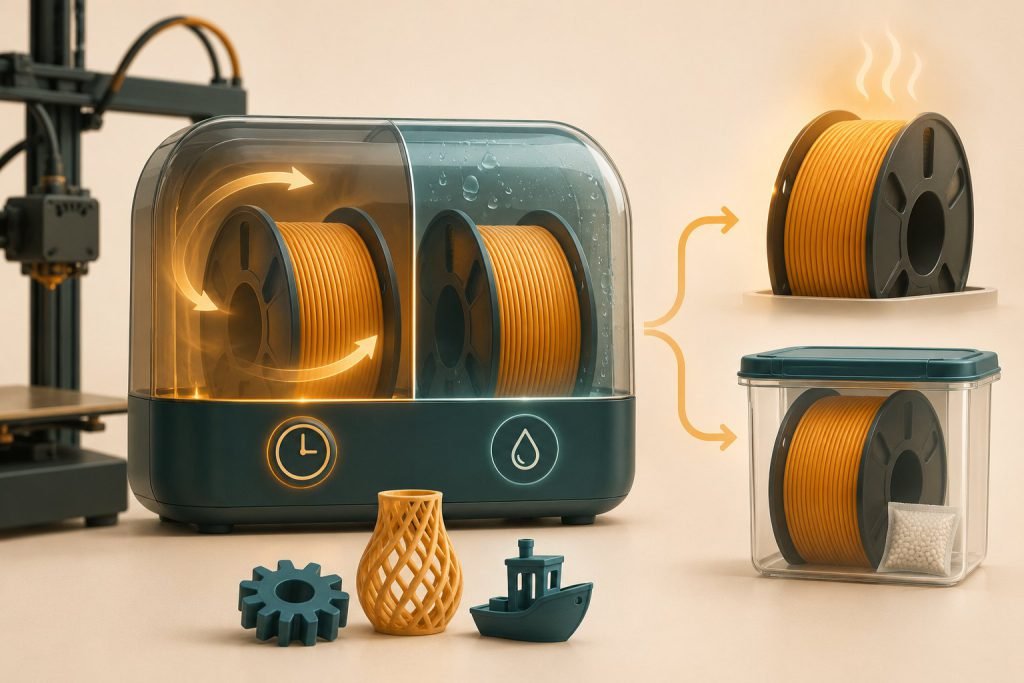
A timer, humidity-triggered mode and continuous mode answer different questions. One schedules a cycle, one reacts to chamber air, and one keeps running until stopped. None directly measures the water remaining inside a spool.
| Mode | Control decision | Still your responsibility |
|---|---|---|
| Timed cycle | Run for a selected duration | Choose the documented material program |
| Humidity-triggered | Restart or stop according to the model’s air-humidity logic | Understand thresholds and permitted storage use |
| Continuous | Continue until the user stops it | Follow the machine’s operating limits and supervision instructions |
The SUNLU S4 documentation describes humidity-triggered operation, while the PolyDryer manual describes a continuous mode. Similar marketing language does not make their control behavior interchangeable.
The S4 example: restart and stop are different thresholds
SUNLU documents a selectable humidity start threshold in the 30–50% RH range and a stop point at 25% RH. For an illustrative selected threshold of 40%, rising chamber humidity triggers the control cycle at that setting; the documented stop point remains 25%. Use your unit’s manual for the controls and revision-specific behavior.
This is chamber-air logic, not a test of water inside the polymer. Load only spools that share a permitted material program and heat-compatible spool construction. For mixed loads, use the shared-cycle checks. The S4 review covers the purchase decision beyond the mode labels.
If your shortlist has reached a manual-control or display-led one-roll choice, the Easdry versus S2 comparison covers the control tradeoff and the operating reservations. A preference for simpler controls is not a reliability rating.
I only want to prepare one spool
Use the exact filament and dryer instructions for a drying cycle, then decide how the spool will be stored. A humidity threshold is not a substitute for the required preparation time.
I want the spool ready between jobs
Check whether the product supports that routine and what happens after power loss or a completed cycle. Compare ongoing heating with sealed storage and desiccant maintenance. Include operating cost and access to the spool.
If the display seems misleading, use the humidity-reading guide. Choose the mode around the routine you need, not the expectation that “automatic” removes every decision.