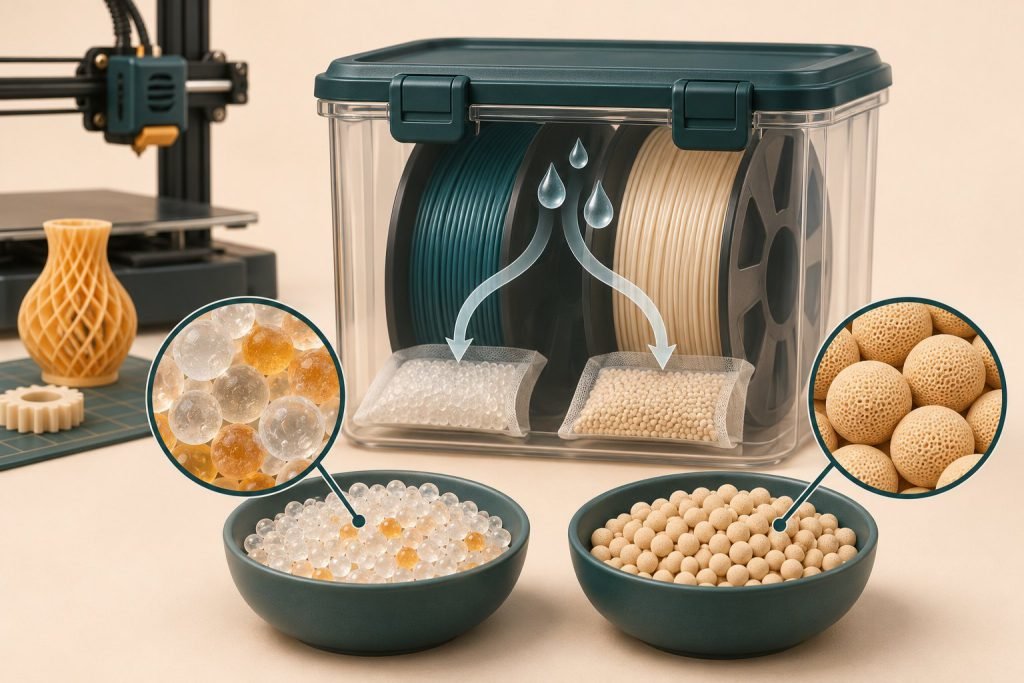
Both silica gel and molecular sieve can protect stored filament. Choose between them using the supplier’s performance curve and handling instructions—not the promise of the lowest number on a small hygrometer.
Choose the maintenance routine before chasing the lowest humidity
| Decision | Silica gel | Molecular sieve |
|---|---|---|
| Ordinary sealed spool storage with home maintenance | A documented reusable packet is a practical starting point. | Choose only if its low-humidity benefit matters enough to justify its maintenance or replacement plan. |
| Very low humidity is required | Capacity drops at low RH; maximum uptake is not the relevant comparison. | Tropack identifies this as a useful operating region for molecular sieve. |
| Equipment available for reactivation | Some consumer packets have explicitly documented oven cycles. | Industrial grades can require high heat plus vacuum or dry purge gas, not just a hot household oven. |
The humidity distinction follows Tropack’s comparison. It does not establish a lifespan in an open or leaking filament box.
Two documented maintenance examples
- Wisedry 10 g Aiwa-paper silica packets: the specified ten-packet batch uses 120°C and a two-sided cycle. Follow the full packet recharging example, including saturation and cooling checks.
- Arkema’s type 3Å molecular-sieve guidance: regeneration uses 250–300°C under vacuum or dry gas. That is a process requirement, not permission to bake an arbitrary sachet at that temperature. See Arkema’s grade distinctions.
Our selection: if you have ordinary spool storage and no documented molecular-sieve regeneration setup, start with maintainable silica gel. For a specified very-low-RH process, evaluate a supported molecular-sieve cartridge and a replacement or regeneration service. These examples compare upkeep; they are not a like-for-like capacity test, so neither supports a claim of “twice as long.”
Spend on the container first
A poorly closed lid keeps exposing the desiccant to room air. Before changing chemistry, inspect the gasket, filament outlets and closure. Log when the box was opened and when the desiccant was renewed; otherwise a “better” refill may simply have been fresher.
Is a lower display reading always better?
Only if it is a meaningful measurement for the storage goal. Check the hygrometer’s operating range and accuracy near the value you want. A display at its lower limit cannot distinguish every further improvement.
For routine storage, a clearly identified refill with manageable upkeep is more useful than an exotic material you cannot maintain. Keep drying and storage as separate jobs: desiccant selection does not replace the filament maker’s drying procedure.