Buy wood PLA for the surface you want to create, then work backward to the required nozzle and finishing process. A wood-like object is still a printed polymer composite. Its appearance does not establish the strength, weather resistance or machining behavior of solid wood.
What does “wood” mean on this spool?
Read the composition and instructions before choosing a profile. A brown color name alone does not establish wood content. Bambu’s PLA Wood documentation, for example, explicitly describes natural wood powder, a matte texture and additional moisture sensitivity. Those details belong to that formulation; do not infer them for a different brown or wood-effect filament.
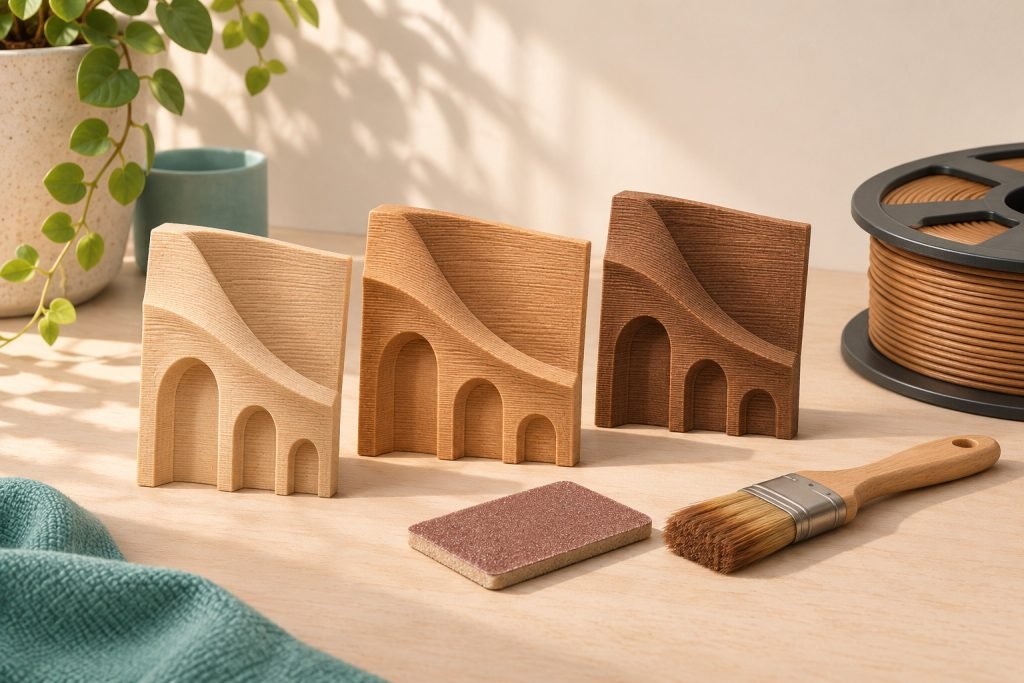
The intended finish helps narrow the choice. If you want an attractive object straight from the printer, inspect a sample of the actual color and texture. If you plan to stain or otherwise finish it, qualify that operation before buying enough material for a large piece.
Choose the nozzle from the formulation
Particle-filled materials can clog a small nozzle. Prusa’s composite-material guidance recommends at least a 0.6 mm nozzle and 0.2 mm layer height for wood-filled materials with larger particles, while noting exceptions for its own materials. Bambu PLA Wood instead explicitly excludes a 0.2 mm nozzle. These are not interchangeable instructions.
Use the exact material’s supported nozzle size and your printer’s installation procedure. Do not turn a broad recommendation into an unsupported setting for every wood filament. If the instructions do not establish whether your installed nozzle is suitable, resolve that before loading the roll.
| Choice | What it changes | What to verify |
|---|---|---|
| A larger nozzle | The printable detail and supported profile | Whether fine lettering or small features still work in the sliced model |
| An automatic feeder | The route and handling demands on the filament | Exact material and feeder compatibility, not a general PLA label |
| A stained finish | The final color and surface preparation | A sample made with the same material, orientation and finish |
| A matching second roll | Continuity across a set | The actual printed shade beside the first part |
Dryness is part of the appearance workflow
Bambu recommends drying PLA Wood before use, including after opening a vacuum-sealed package, and protecting it during storage. It also notes that raw material differences and drying condition can affect color. Follow the applicable drying guidance for the supplied roll and its spool; an ordinary PLA drying shortcut may not match this product.
Keep the first successful sample with a note of the material and profile. When a later roll looks different, compare it under the same light and with the same print settings before assuming the supplier shipped the wrong shade. A photograph on a screen cannot settle a close physical color match.
Try the finish on a useful scrap first
Prusa notes that wood-filled prints can be stained and that particle-filled materials can have weaker layer bonding than their unmodified base material. That makes a small finishing sample useful for both appearance and handling. Do not begin by sanding delicate details on the only completed large print.
- Use a representative surface: include a visible curve or flat face from the final design.
- Keep an unfinished reference: compare the treated surface with the original color and texture.
- Follow the finish manufacturer’s directions: do not assume a coating behaves on a composite exactly as it does on timber.
- Check small details afterward: look for damage and an acceptable surface before repeating the process on the full object.
If you only need an understated surface, the silk-versus-matte guide can help separate the finish decision from a wood-filled formulation. Wood powder is worthwhile when it serves the project’s appearance, rather than simply adding another label to the material choice.
Bring one finished sample to the decision
Before scaling up, confirm the nozzle, the feeding route and the surface you want. A small finished sample is more useful than a large unfinished object in the wrong shade.
I want the print’s natural surface
Judge the color and texture straight from the printer under the intended light. Keep that sample when ordering matching material.
I want to stain or coat it
Try the complete finishing process on a representative small print, retaining an untreated reference. Scale up only when the resulting surface and detail suit the project.