
Overture Matte PLA review: choose it for the exposed surface
At a glance
Choose for low-gloss indoor models; qualify the finish and reel before a long print.
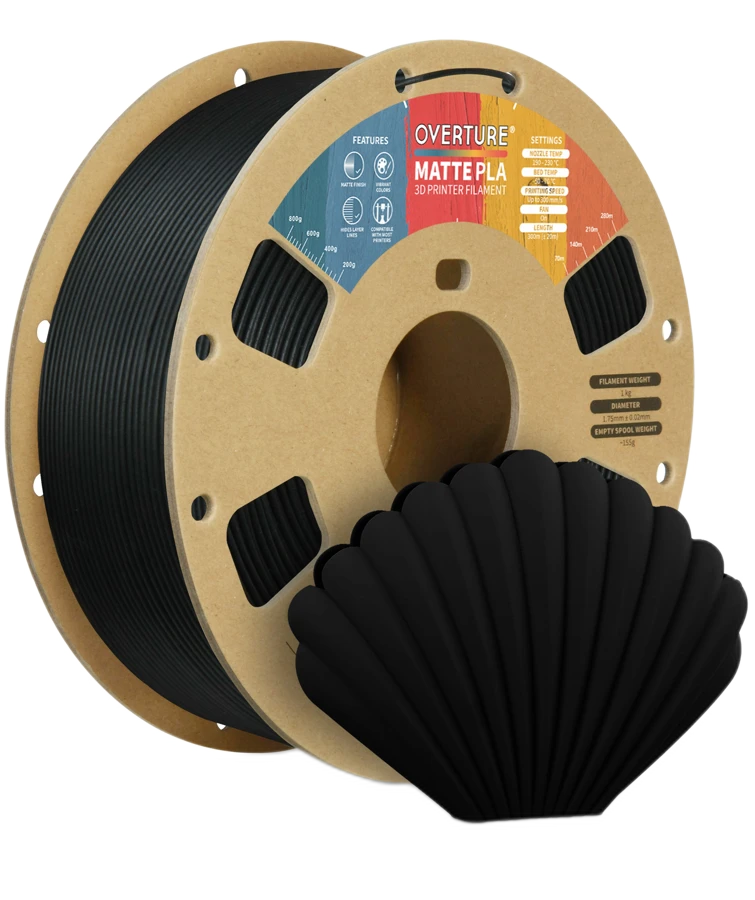
The material & format
- Matte PLA formulation in a one-kilogram spool.
- Selected Amazon offer: Matte Black, 1.75 mm.
- Several colors share the review page; color-specific findings remain separate.
Why consider it
- Low-gloss black finish can make printed layers less conspicuous.
- Encouraging results for visible models and repeated everyday printing.
What to weigh up
- Appearance comes with a documented strength tradeoff against standard PLA.
- Finish and small-detail results can require tuning.
- Inspect cardboard reels before using roller-fed equipment.
A low-gloss surface is the reason to consider Overture Matte PLA. It is a promising choice for display models, decorative pieces and visible prototypes that you would prefer to leave unpainted. Choose it because you want that appearance—not because the word “matte” guarantees easier printing or stronger parts.
What should the finished object look like?
A finished black display piece
Black-spool feedback describes clean detail and less conspicuous layers on models and props. That can reduce the need to disguise a glossy printed surface.
A perfectly flat, reflection-free surface
Set a more cautious expectation. The finish is also described as satin-like. Judge a small sample under the light where the object will be displayed.
Less visible layering is different from removing layer geometry. Orientation, curved faces and viewing distance still matter. Before adding another finishing step, decide whether the remaining texture is actually distracting; ironing addresses selected top surfaces, not every visible face.
Keep appearance and strength on separate checklists
Overture’s material guidance warns that Matte PLA has lower strength and layer adhesion than standard PLA. This makes appearance-led indoor projects a clearer buying case than choosing it to improve a loaded bracket.
| Your project | Buying decision |
|---|---|
| Decorative model or display piece | Try the finish on a small part with the same visible faces and detail. |
| Prototype for checking fit | Judge fit separately from the surface. A good-looking prototype has not validated service loads. |
| Small detailed miniature | Prove adhesion and fine features first; a matte surface cannot rescue a detached part. |
| Part chosen mainly for strength | Compare the relevant material properties before paying for an aesthetic finish. |
The first useful print is a surface sample
A temperature tower is useful when you compare more than surface gloss: check whether the attractive section also has acceptable detail and bonding.
Check the reel as well as the result
Inspect the cardboard edges and watch the spool rotate in its intended holder. The first-page feedback includes a chocolate-spool report of distorted flanges catching in roller-based equipment, alongside favorable printing experiences with other rolls. That is a useful inspection point when printing directly from a dryer; it is not evidence that every spool has the same problem.
Drying helped that troublesome experience, but it does not follow that all new rolls arrive unusable. Separate moisture symptoms from mechanical drag. A drying cycle cannot straighten a bent flange, and a new temperature setting cannot free a trapped reel.
Pros & Cons Analysis
Based on supplied customer reviews and verified product documentation
Pros
- A useful finish straight from the printer. Black-spool feedback describes attractive detail without relying entirely on paint. This is most relevant when the printed surface remains visible. Expect reduced sheen rather than guaranteed invisible layers or a completely flat finish.
- The appeal extends beyond a single showpiece. Repeated black-spool use supports considering it for a familiar model-making routine. Start with the actual geometry you intend to repeat; favorable accounts do not establish an uninterrupted success rate.
Cons
- Do not select the aesthetic formulation as a strength upgrade. The manufacturer explicitly distinguishes its mechanical performance from standard PLA. For a loaded part, qualify the design and material rather than treating favorable appearance feedback as strength evidence.
- Temperature and detail can change the buying experience. A black-spool account describes improved smoothness after tuning; a historical light-gray miniature needed more adhesion work than larger parts. Those are different situations, but both favor a representative trial over assuming a ready-made profile is sufficient.
- Free rotation deserves an arrival check. A chocolate-variant account connects damaged cardboard flanges with interruptions in roller-fed equipment. Inspect the supplied reel before committing to an unattended job; the report does not establish the condition of current black stock.
Buy the finish you want to leave exposed
Overture Matte PLA is worth trying when a less reflective printed surface would save you finishing work. A small trial is more informative than committing immediately to several colors.
I want an unpainted display model
Start with the black spool and a representative visible surface. Keep it if the sheen, detail and layer visibility match the intended display.
I print through a dryer or roller holder
Inspect the flanges and free rotation before the long job. Separate a reel problem from an extrusion problem.
The part must carry a load
Make the mechanical requirement your first filter. A matte finish is not a reason to accept an unsuitable material.
Frequently Asked Questions
Is Overture Matte PLA completely non-reflective?
Not necessarily. Black-spool feedback includes a satin-like finish. Test it under the lighting where the part will be used.
Can I assume every matte color prints the same?
No. The collected page pools colors and older accounts. Use the exact color and geometry to establish a profile before repeating a long job.
Will the matte finish eliminate layer lines?
It can make them less conspicuous, but the surface geometry remains. Layer height, orientation and lighting still affect what you see.
Technical Specifications
| Product type | PLA-based filament |
|---|---|
| Reviewed formulation | Overture Matte PLA; selected offer Matte Black. Other colors identified separately in the analysis. |
| Nominal filament diameter | 1.75 mm |
| Manufacturer diameter tolerance | ±0.02 mm (manufacturer specification) |
| Package format | 1 kg spool |
| Nozzle guidance | Manufacturer: 190–230°C; match the supplied roll and printer profile |
| Material care | Manufacturer drying guidance: 50°C for 7 hours |
| Variant / handling limit | Not regular PLA or PLA Pro; color and spool condition can affect the buying decision |

ELEGOO Rapid PLA Plus

Bambu Lab PLA Matte

Polymaker HT-PLA Pro

PolyMax PLA