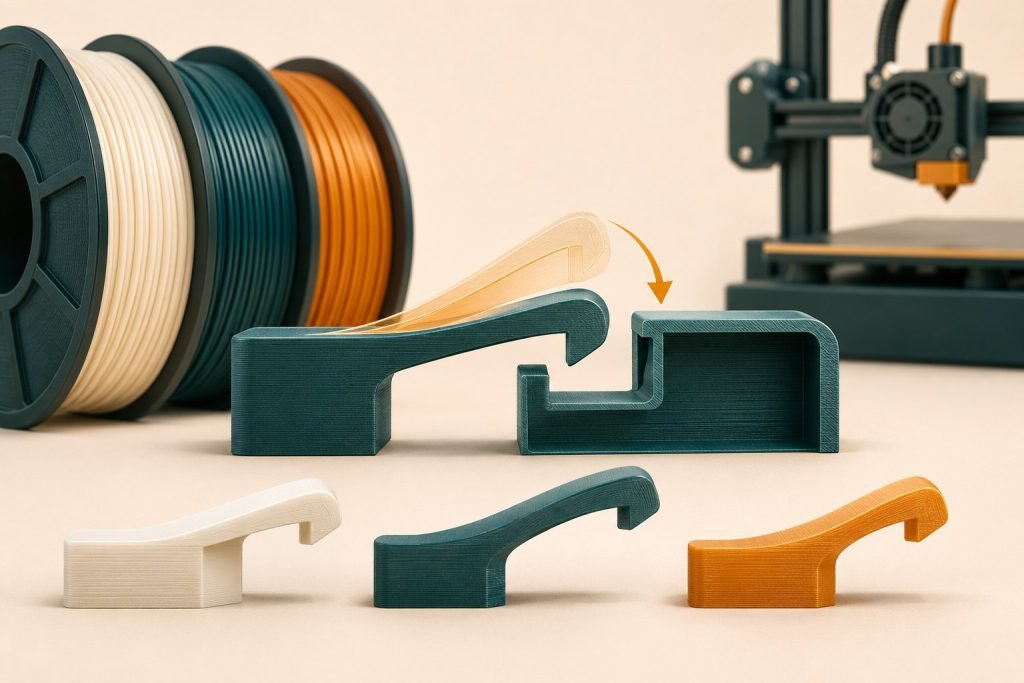
A snap fit needs enough movement to assemble and enough recovery to hold. Selecting a “strong” filament without checking the latch geometry can produce a clip that is difficult to close or breaks on the first release.
Define the latch’s job
- Will it close once or open repeatedly?
- How far must the arm bend to pass the catch?
- Must it hold while warm or under continuous force?
- Can the user reach the release point without overbending it?
Formlabs’ snap-fit design guide treats material, geometry and printing process as a combined decision. Its SLA and SLS examples should not be copied as validated FDM dimensions.
| Prototype result | Useful change to explore |
|---|---|
| Arm barely moves | Length, thickness and available bending space |
| Crack at the root | Transition geometry and layer orientation |
| Closes but does not hold | Catch engagement and recovery |
| Holds but cannot release | Accessible release travel and catch shape |
Should I switch from PLA to PETG?
Compare exact formulations and the latch’s needed response, rather than assuming a polymer swap repairs the design. The mechanical-property guide explains why stiffness and toughness are different requirements.
Make a latch trial that isolates the cause
- Print the mating latch and catch at their real dimensions, in the final part’s intended orientation. A miniature whole box changes the bending problem.
- Mark the latch position before assembly. Close it using the intended hand motion and note where resistance starts.
- After release, compare the rest position and inspect the root and layer boundaries. Record “returned,” “stayed bent,” or “cracked,” rather than just “strong.”
- Change one geometry feature—such as catch engagement or arm thickness—and keep material and slicing fixed for the comparison.
| Version | One change | Closes / holds / releases | After release |
|---|---|---|---|
| A | Baseline | ___ / ___ / ___ | ___ |
| B | ___ | ___ / ___ / ___ | ___ |
If every version fractures along the same layer boundary, examine orientation before comparing another resin family. If it closes but remains bent, recovery is the unresolved requirement. Neither observation establishes long-term fatigue life or hot-service suitability.
Print just the mating latch region first. Keep orientation, wall construction and clearance representative of the final enclosure. Test the intended opening action, record deformation or damage, and revise before making the whole box. A short prototype trial does not establish long-term fatigue life.