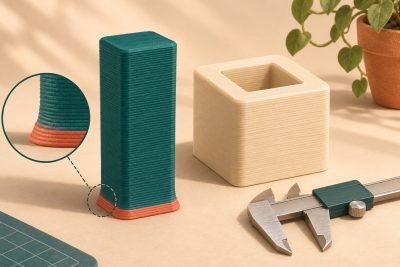
Start with what the finished part must do. Ordinary PLA is a useful starting point for detailed display pieces and prototypes; PETG deserves consideration when a functional part needs more toughness. Prusa’s PLA guide and PETG guide describe those broad tradeoffs, but a material-family label is not a guarantee for a specific printed design.
| Priority | What to examine |
|---|---|
| Appearance and small detail | Start with an ordinary PLA candidate and its recommended profile. |
| A part that must tolerate knocks | Compare a named PETG formulation’s data with the actual job. |
| Heat or sustained mechanical load | Require specific material and design evidence; neither family name is sufficient. |
| An existing printer and build plate | Check the exact filament and plate instructions before buying. |
Once the material family fits the job, use the PLA shortlist for reviewed everyday and refill choices, or the PETG shortlist for formulation and roll-handling tradeoffs. Neither list supplies a load or temperature rating for your design.
Include printing constraints in the decision
Prusa describes ordinary PLA as relatively straightforward to print but limited by heat resistance and brittleness. Its PETG guide discusses stringing, more difficult support removal and strong adhesion to smooth PEI. Follow the exact build-sheet procedure; advice for one surface is not a universal release-agent instruction.
Write down your nozzle, build surface and available material profiles. A promising filament is still a poor immediate choice if you cannot establish a supported setup for it. When comparing two brands, keep their recommended profiles separate instead of copying a generic temperature from another spool.
Write the part’s job before choosing its plastic
“A bracket” leaves too much unanswered. Identify where the part sits, whether it flexes, what it holds and whether failure matters. Choose the simplest supported material that meets that actual requirement.
Which requirement controls the decision?
It is a display piece or a prototype
An ordinary PLA candidate may be the useful starting point. Confirm the intended finish and profile; use the PLA+ comparison method if a claimed upgrade is part of the choice.
It needs toughness or a functional PETG workflow
Compare a named formulation and its build-surface instructions, then establish its preparation requirements.
It depends on heat resistance or sustained load
Neither family name is sufficient. Require comparable material data and validate the finished design for the use, rather than inferring suitability from the label.