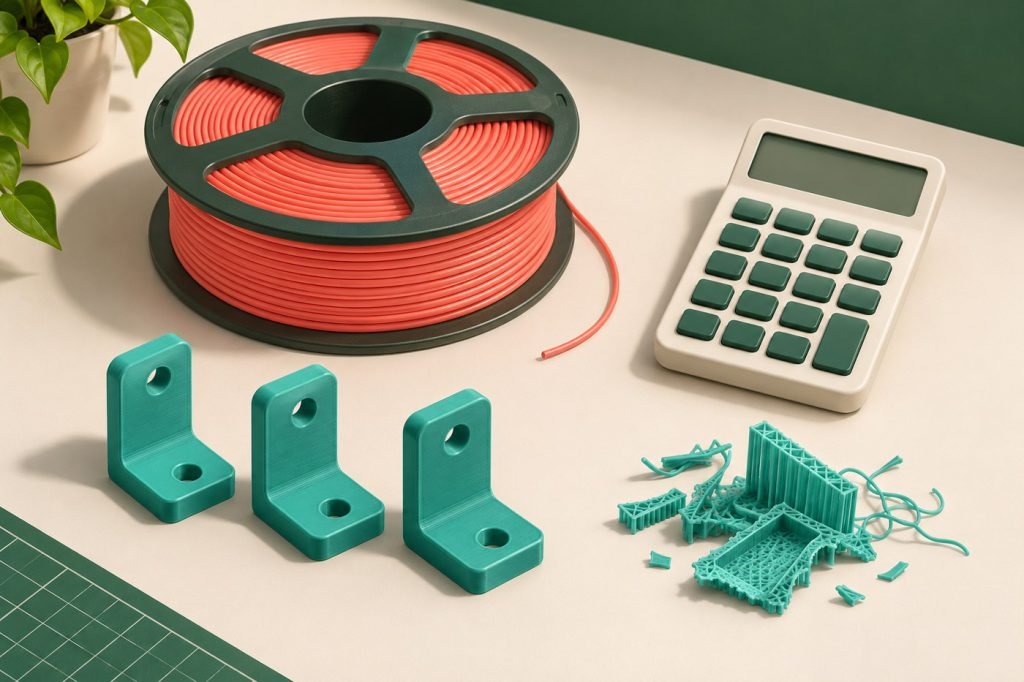
The price of a roll is only the starting point. To compare filament sensibly, calculate the material cost of the complete job, then look at how many usable parts it produced. A cheap spool is not automatically the cheaper choice for your project, and a premium spool does not earn a lower cost simply by claiming better results.
Use your purchase price, your sliced job and your own outcome record. The figures below are illustrative arithmetic, not current offers or measured failure rates.
Put every offer on the same weight basis
Divide the amount paid for the filament by its net filament weight. Packaging and the empty reel are not printable material. If you include shipping or other purchase costs, use the same approach for every option; do not compare a delivered price with an item-only price.
| Hypothetical offer | Price per kilogram | Material cost for a 60 g job |
|---|---|---|
| $24 for 1,000 g | $24/kg | $1.44 |
| $15 for 500 g | $30/kg | $1.80 |
| $42 for two 1,000 g rolls | $21/kg | $1.26 |
The half-kilogram offer has the lowest checkout amount in this example but the highest cost per gram. The two-roll bundle has the lowest unit cost only if its material and colors are useful to you. Buying an unwanted second color is not the same as saving on the material you need.
Use the same calculation with your own receipt
Cost per gram = allocated purchase cost ÷ net filament grams.
Job material cost = cost per gram × total job grams.
For the first example: $24 ÷ 1,000 g = $0.024/g; 60 g × $0.024/g = $1.44. Keep a few extra decimal places in the unit cost and round the final money amount.
Charge the job for everything it consumes
Use the final slice after choosing orientation, supports, adhesion structures and material changes. The displayed weight of a single model can omit other work on the plate. For multiple materials, calculate each material’s contribution using its own unit price and add the results.
- Model plus support: a 40 g object with 20 g of supporting structures uses 60 g for this estimate, not 40 g.
- Multiple colors: include the slicer’s purge and wipe allowances without adding them twice if they are already in the total.
- Preparation outside the slice: account separately for material you actually consume while loading or qualifying the setup.
If you also need to know whether a part-used roll can finish the job, compare the total with the filament remaining. A cost estimate and a stock check answer different questions.
Record the cost of usable output
Suppose three attempts consume 60 g each, and two parts meet your requirement. At $0.024 per gram, the material consumed is 180 g costing $4.32. Dividing that by two accepted parts gives $2.16 of material per usable part.
This is an accounting example, not a predicted failure rate. Do not apply a guessed success percentage to a brand because of a handful of online complaints. If you are deciding between materials, keep a small record of the actual projects, material consumed and accepted output under your conditions.
| Record | Why it belongs in the comparison |
|---|---|
| Acceptance requirement | A fit check, painted prop and exposed display model may accept different results. |
| Material and profile | A different color or setup can change what the comparison represents. |
| Total consumption | Include attempts and preparation attributable to the job. |
| Accepted parts | Count parts that meet the requirement, not simply completed prints. |
Keep filament cost separate from the whole project
Electricity, preparation time, finishing, machine upkeep and purchased hardware are separate costs. Prusa’s printing-price calculator provides fields for several of these categories. Replace its defaults with your own inputs; a preset number is not evidence of your costs.
For a hobby purchase, you may simply want to know whether a particular finish is worth an extra few cents of material on each part. For repeat production, time spent removing supports or reworking a surface can also matter. Keep these categories visible so a material-only comparison is not mistaken for a full project budget.
Make the next spool comparison concrete
Choose one representative job and write down three values: delivered cost per gram, complete job grams, and the number of parts that meet your requirement. That gives you a useful comparison to revisit after printing.
Buy for the result you need. The lowest roll price is a useful fact; it is not the entire value decision.