
SUNLU TPU 95A review: useful flexibility, with string cleanup to plan for
At a glance
A practical flexible-part option; check the feel and budget for string cleanup.

The setup
- TPU with a nominal 95A Shore hardness.
- Selected offer: black, 1.75 mm, one-kilogram spool.
- Separate formulation from SUNLU TPU 90A.
Why consider it
- Useful flexibility for covers, cases and grips.
- Encouraging feeding and layer-bonding experiences.
What to weigh up
- Travel-heavy models can need string cleanup.
- Flexible does not guarantee a soft, easily squeezed part.
SUNLU TPU 95A is a sensible candidate for flexible covers, grips and similar parts when you are ready to tune a TPU profile. The appeal is usable flexibility with encouraging feeding results. The main compromise is finishing work: a successful flexible print can still leave strings to remove.
Start with how the part should bend
Do you want a cover that flexes around an object, or something that feels soft when squeezed? Those are different requirements. The black-spool feedback supports practical covers and cases. A transparent-blue experience describes a ball that was firmer than expected, despite limited walls and infill.
Bend around a shape
Cases, covers and grips are the clearest starting point in this feedback. Print the tightest bend and attachment detail before the whole object.
Compress easily in your hand
Do not buy on the word flexible alone. Make a small sample with the planned walls and infill, then judge the feel.
The blue-spool result is a reason to check geometry, not proof that the black formulation has exactly the same stiffness. Neither the 95A label nor an attractive finished part validates a pressure seal, a protective component or a service lifetime.
Clean extrusion does not always mean a clean gap
Black-filament feedback includes both smooth, low-stringing results and noticeable strings on models with travel moves. That difference matters most when the design contains separated towers, recesses or small openings where cleanup is awkward.
Before committing to the full part
What the trial should tell you: Can you clean up the strings without damaging the flexible edges?
What the trial should tell you: Does it flex enough while retaining the intended shape?
What the trial should tell you: Does the spool unwind freely throughout the movements the real job will use?
Successful feeding is a positive theme, but it does not remove the need to check the setup. The Bambu experience in this page uses an external mount. It does not demonstrate compatibility with an automatic material system.
Set your speed after the surface works
Some experiences describe printing faster than expected; another uses a much slower routine successfully. They do not form a controlled speed comparison. Start with a suitable TPU profile for the actual machine, inspect bonding and stringing, and increase throughput only while those results remain acceptable.
Moisture management appears in the successful routines, but the evidence does not establish that every new spool is wet. If results deteriorate, separate the filament condition from travel settings and mechanical drag. Changing all three together makes it harder to identify what improved the print.
Pros & Cons Analysis
Based on supplied customer reviews and verified product documentation
Pros
- There is a practical use for the flexibility. Covers and cases recur in the black-spool feedback, making these a better starting point than buying TPU just to try a different material. Verify the tightest bend and fit on your own design; reported success does not qualify a seal or protective function.
- The feed process need not be the main obstacle. Several black-spool experiences describe continuous extrusion and good bonding. That supports a trial on a suitable machine, while keeping the actual filament path and feeder compatibility separate.
Cons
- Small gaps can add finishing effort. The same black variant receives both clean-surface praise and a stringing complaint. A travel-rich test is useful before printing flexible details that would be difficult to trim.
- Softness needs a physical sample. The transparent-blue ball experience was firmer than expected. Treat it as a warning against predicting feel from a flexible-material label, not a measured black-spool hardness comparison.
Try the bend, the gap and the feed path first
SUNLU TPU 95A earns consideration for useful flexible shapes. A short representative print should settle whether its feel and cleanup suit your project.
I need a flexible cover or grip
Try the fit and tightest bend. Proceed if the shape holds while flexing as intended.
I need a very soft object
Validate the feel before buying several rolls. Compare hardness and geometry choices rather than assuming all TPU behaves alike.
I need clean, intricate gaps
Start with the most travel-heavy detail. If string removal damages it, resolve that before the full model.
Frequently Asked Questions
Will SUNLU TPU 95A print without strings?
Not reliably on every setup. Black-spool feedback includes both clean results and stringing. Test a gap-heavy feature with the intended profile before a detailed model.
Does the Bambu feedback establish AMS compatibility?
No. The captured successful account describes an external mount. Check the exact feeder documentation separately.
Technical Specifications
| Product type | Flexible TPU filament |
|---|---|
| Formulation | SUNLU TPU 95A; not TPU 90A |
| Nominal Shore hardness | 95A |
| Filament diameter | 1.75 mm; manufacturer tolerance ±0.02 mm |
| Reviewed package | Black, 1 kg spool |
| Manufacturer nozzle guidance | 190–210°C at 50–80 mm/s; 210–230°C at 80–120 mm/s |
| Manufacturer bed guidance | 50–60°C |
| Feeding compatibility | Confirm the exact printer and feeder; external feeding reports do not establish AMS compatibility |
| Drying and storage | Exact drying schedule not verified in the checked product page; follow the supplied roll instructions |

PolyFlex TPU95

PolyFlex TPU95-HF

ELEGOO TPU 95A
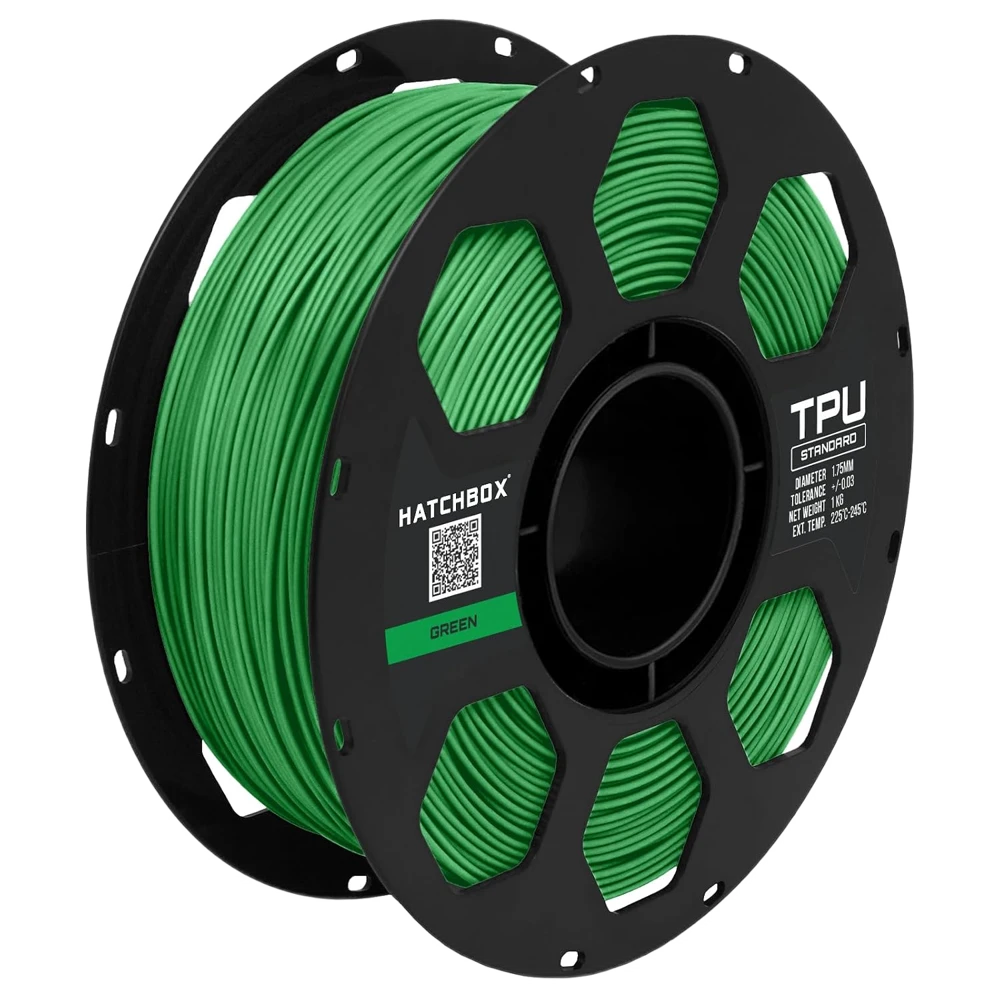
HATCHBOX TPU 95A