
HATCHBOX TPU 95A review: flexible parts reward a controlled feed path
At a glance
Useful flexible prints appear in matching TPU feedback, but feeding, stringing and thin sections require more care than ordinary PLA.
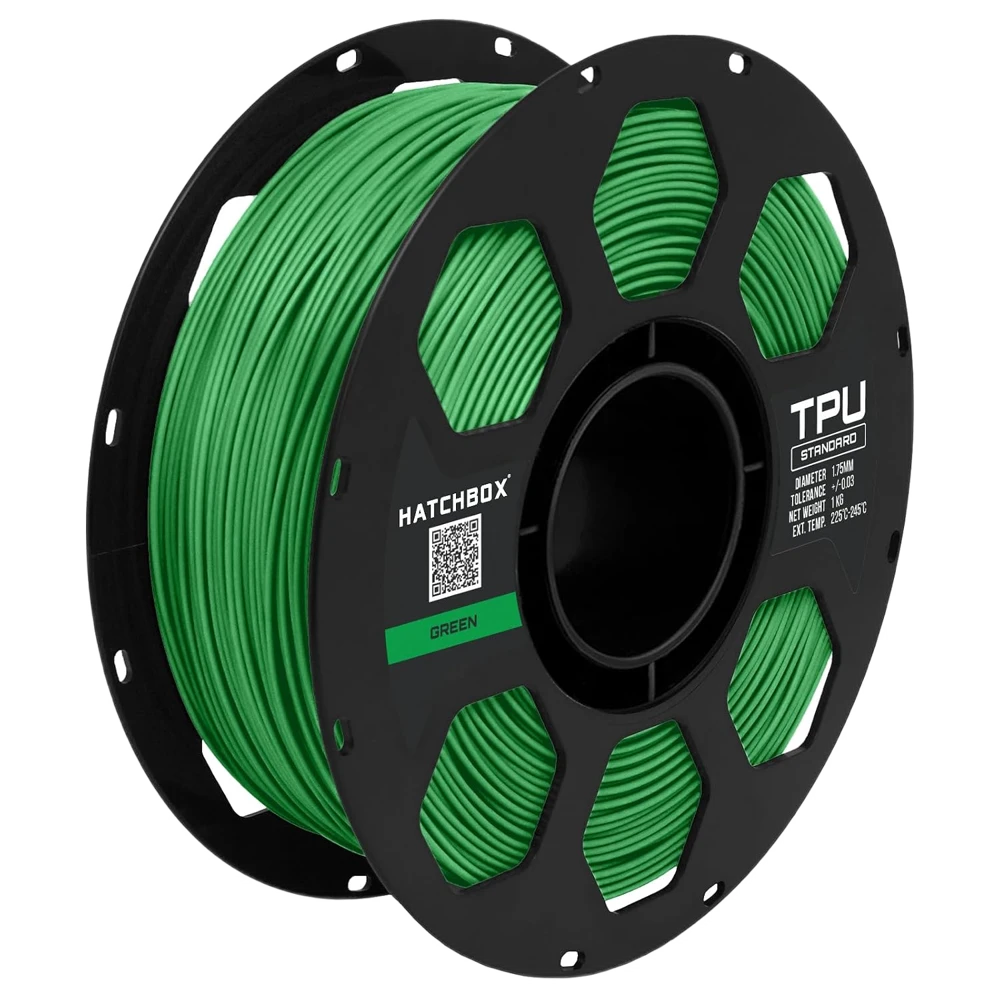
The setup
- Shore 95A TPU
- Selected green 1 kg spool
- 1.75 mm diameter
Why consider it
- Useful flexibility for brackets and damping applications.
- Successful output is possible on several feed arrangements.
What to weigh up
- Loading and feeding need more attention than rigid PLA.
- Stringing and delicate sections remain concerns.
HATCHBOX TPU 95A is a candidate for parts that need give rather than PLA-like rigidity. The selected offer is green; the captured family experiences cover several colors, so they inform the workflow rather than proving a particular green shade or strength.
Start with the bend, not the full model
Print the feature that must flex: a strap section, a bracket corner or the wall that will be squeezed. A soft-feeling material can still tear when the geometry concentrates strain. One purple TPU experience specifically raises that concern for thin sections.
Follow the strand through the printer
- Loading: confirm the machine supports this flexible material.
- Feeding: avoid treating ordinary PLA throughput as a suitable target.
- Release: follow the actual plate’s TPU guidance; strong bonding can complicate removal.
Successful bracket and damping-related prints are encouraging. They sit beside reports of stringing, loading difficulty and large-part failures before tuning. The useful purchase is a qualified flexible workflow, not simply a spool labeled 95A.
Additional configuration details
| Manufacturer diameter tolerance | Listing: ±0.03 mm |
|---|
Pros & Cons Analysis
Based on supplied customer reviews and verified product documentation
Pros
- The family evidence describes practical objects. TPU accounts include flexible brackets and vibration-related parts with satisfactory results. These applications illustrate the material’s role without establishing a rated load or measured damping value.
- The route matters more than a universal speed claim. Matching TPU feedback includes direct-drive and carefully arranged Bowden workflows. Those setups were tuned; they do not make every extruder equally suitable.
Cons
- A flexible strand can buckle instead of advancing. Accounts describe difficult changes and unsuccessful larger jobs before tuning. Check the complete feed route rather than copying one motion-speed number.
- Flexibility is not immunity from failure. Family feedback includes persistent strings and a purple part that tore in thin areas. Qualify the intended wall geometry and do not infer green-specific strength from another color.
Choose it for a tested flexible geometry
Try HATCHBOX TPU 95A when the printer supports a controlled flexible-filament route. Approve the bend, thin sections and release behavior before printing the complete component.
Frequently Asked Questions
Does Shore 95A determine how flexible my finished part will be?
It describes the material hardness; geometry and printing choices also affect the finished part. Test the feature that needs to flex.
Do these experiences establish the exact green shade?
No. The selected offer is green, while the captured family feedback spans other colors and does not establish a green color match.
Technical Specifications
| Product type | Flexible TPU filament |
|---|---|
| Formulation | HATCHBOX TPU 95A; green selected |
| Nominal Shore hardness | 95A |
| Filament diameter | 1.75 mm |
| Reviewed package | 1 kg spool |
| Manufacturer nozzle guidance | Listing: 190–235°C nozzle; use TPU-compatible feed route |
| Manufacturer bed guidance | Follow the supplied HATCHBOX TPU profile; no additional range verified here |
| Feeding compatibility | Family evidence spans colors; no green-specific performance measurement |
| Drying and storage | Store dry; follow the current exact-material drying instructions |

eSUN TPU 95A

PolyFlex TPU95-HF

colorFabb varioShore TPU
ELEGOO TPU 72D