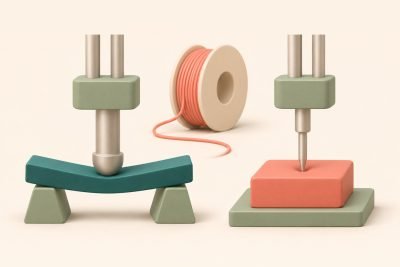
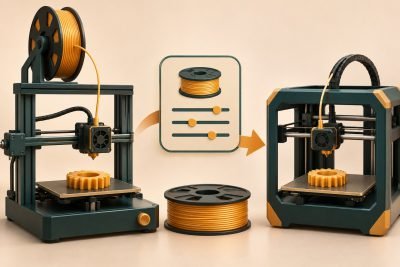
A soft filament can still produce a surprisingly stiff part when it is printed as a thick, nearly solid structure. Decide whether you need easier bending, easier compression or a softer contact surface; those are different goals.
| Desired change | Design variable to compare | Check afterward |
|---|---|---|
| Easier bending | Thickness and length of the flexing section | Return to shape and stress at the attachment |
| Easier squeezing | Walls, top/bottom thickness and infill | Whether the surface remains intact |
| Softer material response | Another documented TPU formulation | Printer compatibility as well as feel |
Prusa’s flexible-material guidance identifies perimeter and solid-layer counts as important flexibility controls. Reducing them also changes the support available to surfaces, so inspect the slice before printing.
Make a three-piece trial
- Print a small section using the existing design.
- Change one structural setting in a second version.
- Change one modeled dimension in a third version.
- Label them and compare the actual motion you need.
Can Shore hardness predict the finished feel?
It describes the material under a specified test, not the stiffness of every printed shape. Compare TPU hardness grades alongside geometry and printing requirements, rather than replacing a shape trial with a number.
Keep enough material around mounting points and thin connections. Choose the version that moves as intended without tearing or remaining distorted. A successful hand-flex check is a useful prototype observation, not a fatigue or load certification.