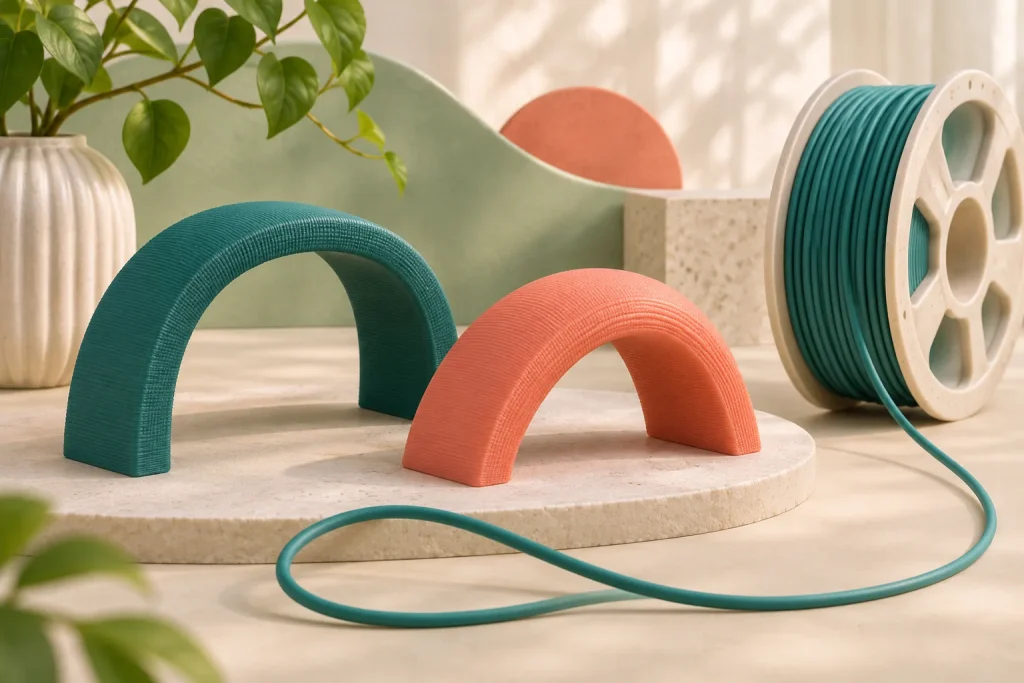
On the same Shore A scale, 90A denotes a softer material than 95A. That helps narrow a TPU choice, but it does not tell you how a hollow printed part will feel, how quickly the filament can be fed or whether it will work in a particular multi-material system.
Separate the material from the shape
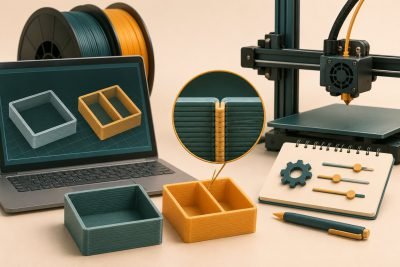
Start with the job: a compliant cover, a gripping foot or a flexible sleeve. Then record the wall layout and infill along with the material. Comparing a thick, nearly solid 90A part with a thin-walled 95A part confounds material hardness with design. Keep geometry and print construction comparable when deciding which formulation suits the intended movement.
Prusa’s flexible-material guide describes the increased printing difficulty of softer filament and the role of print settings. Use that as context, not as a fixed speed prescription for every modern TPU.
What the hardness label can—and cannot—answer
| Question | Does 90A versus 95A settle it? |
|---|---|
| Which has the lower declared Shore A hardness? | 90A, when both values use that same scale. |
| Which printed part bends more easily? | Not by itself; keep geometry, walls and infill in the comparison. |
| Which prints faster? | No. Look for the exact line’s flow characteristics and supported profile. |
| Which works in my feeder? | No. Require explicit compatibility for the material and feeding system. |
| Which tolerates the application? | No. Check the relevant material data and the finished design. |
A real formulation difference beyond the number
Polymaker labels PolyFlex TPU90 as 90A and TPU95-HF as 95A with a high-flow formulation. Its listed speed ranges differ: 30–60 mm/s for TPU90 and 40–100 mm/s for TPU95-HF. These are the manufacturer’s named-product settings, not a universal conversion from hardness to printing speed.
The practical implication is to compare full product names. A listing shortened to “TPU 95A” can conceal the very formulation difference that motivated the purchase. The TPU drying guide shows why preparation instructions also need the full identity.
Choose a first experiment that answers your question
For a non-critical household prototype, print the section that must flex or fit, rather than a large finished object. Keep its dimensions and construction recorded. Judge the movement and recovery needed for the job, then change one variable at a time. This is a suggested evaluation method, not a test result from this site.
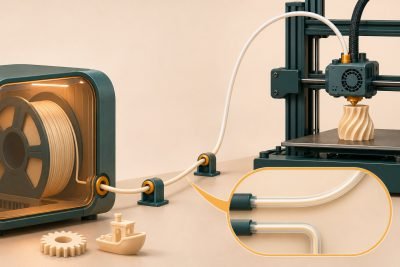
Before loading, verify the feeder’s TPU support and the manufacturer’s profile. A convenient enclosed spool path is not automatically a supported path for a flexible material. If a multi-material system does not explicitly support the exact TPU, use only the printer maker’s approved alternative arrangement.
Which uncertainty should you resolve first?
Choose between 90A and 95A around the required feel and a supported feed path. Neither number substitutes for an exact formulation or a suitable part design.
Pick the question that is still open.
I need a softer-feeling part
Consider a lower-hardness candidate, then compare the relevant section with consistent geometry and construction.
I need reliable loading or higher throughput
Resolve feeder compatibility and the named material’s profile before choosing on hardness alone. High-flow is a separate formulation claim.