
SUNLU FilaDryer E2 Review: A Nylon-Focused Upgrade with Practical Compromises
At a glance
A demanding-filament workflow with useful drying and part-treatment reports, offset by fit, controls and unresolved supplied-version details.
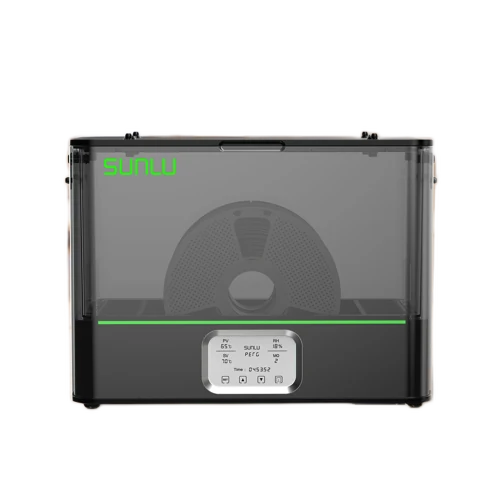
The setup
- Documented drying, annealing and humidity-control modes.
- Separate annealing tray.
- Timed operation with fan cooldown.
- Print-through routing for compatible spools.
Why consider it
- Useful PA6-CF preparation in successful setups.
- Annealing adds a separate workshop function.
- Direct feeding can reduce spool handling.
What to weigh up
- Supplied electrical and hardware revision needs confirmation.
- Large reels can fit or feed poorly.
- Controls and fan sound divide opinion.
- Faults and mixed support outcomes warrant early inspection.
The E2 makes its strongest case when drying engineering filament is a recurring bottleneck. Customer feedback describes improved PA6-CF printing and useful annealing capability, but also fan faults, awkward controls and inconsistent large-spool fit. For a desk used mainly for PLA, those compromises make it harder to justify.
Start with the material that is holding up your prints
The most useful positive feedback comes from nylon users describing a practical change: filament that had been difficult to print became easier to use after drying in the E2. That supports considering it when your present dryer does not meet the filament maker’s requirements. It does not establish one drying time for every nylon, or prove that every print defect is moisture-related.
Several favorable accounts discuss drying without having tried annealing. Treat those as two separate purchase decisions. A successful spool-drying report cannot demonstrate stronger annealed parts, and an advertised temperature ceiling is not a verified temperature throughout a loaded spool.
Large-spool fit needs more than a kilogram label
Check before buying
Why it matters: Some customers use 3kg rolls successfully; others cannot close the lid over their rolls. Weight alone does not establish fit.
Why it matters: Reports of tilted spools and excessive drag make support and alignment important when printing directly from the box.
Why it matters: An offset path can pull a wide spool toward one side. Confirm a workable route for your printer before committing to a long job.
These are different questions. A roll that fits inside for drying may still feed poorly. If a specific bulk spool is the reason for buying the E2, obtain a dimension-based fit confirmation for that spool and the version being supplied.
Drying and annealing compete for the same work time
Annealing adds value for customers who actually use it. The limitation is the workflow around the heat: feedback describes manual intervention and a desire for programmable warm-up and controlled cooling. Confirm the current manual’s controls before expecting a set-and-forget annealing process.
Plan the sequence, too. If the dryer is occupied by a spool feeding a long print, you may have to wait before preparing it for a separate annealing job. Buying one enclosure for both tasks is useful only when your schedule accommodates that changeover. Our mixed-filament drying guide helps separate compatible cycles from jobs that need their own treatment.
What the documented modes actually do
The current E2 manual separates timed drying, annealing and humidity control. Timed drying and annealing end heating at the countdown, followed by three minutes of fan cooldown. Humidity control can restart heating after the timed stage. These are different behaviors: select the mode deliberately, and use the filament maker’s annealing instructions.
The version question is still important
The Amazon listing checked for this review advertises a 500W heater. SUNLU’s current product page states 325W and distinguishes old and current options. The official store also advertises 500 W PTC heating, while the downloadable manual does not specify operating wattage. Customer feedback describes changes to the lid and feet. Those observations do not prove which electrical revision a particular seller will deliver.
Do not combine the most attractive specifications from different versions. Ask the seller to confirm the rating label, lid design, usable spool dimensions and included accessories for the actual unit. The published documents do not resolve which hardware revision a particular seller will supply.
Pros & Cons Analysis
Based on supplied customer reviews and verified product documentation
Pros
- A purpose-built option for demanding filament preparation. PA6-CF feedback repeatedly describes useful printing improvements. The benefit is strongest when it addresses a documented drying requirement that your existing equipment cannot meet.
- Useful part-treatment capability. Customers who have used the annealing function describe it as an additional workshop tool. Its value depends on the actual material recipe and part fit; it is not a universal treatment for all printed plastics.
- Direct feeding can simplify long jobs. Successful nylon workflows include keeping a spool in the dryer while printing. That convenience is conditional on smooth spool rotation and a suitable outlet path.
Cons
- Fan and startup faults deserve attention. The evidence includes units that stopped working, fan-related error reports, and replacements that subsequently worked well. Inspect operation promptly; these accounts do not establish a failure rate.
- A bulk-spool claim is not a fit guarantee. Successful three-kilogram use coexists with lid-clearance failures and one-sided feeding. Confirm dimensions and rotation for the actual reel; a roll can fit for drying yet pull poorly during printing.
- The controls divide opinion. Some users find the interface straightforward, while others dislike changing settings, viewing the display and managing annealing stages. Confirm the functions you need rather than treating a preset list as proof of a convenient process.
- Noise may be noticeable at a shared desk. Reports range from acceptable workshop background noise to irritating fan tones. There is no standardized measurement here that supports calling the machine silent.
- Support outcomes vary. Successful replacement-part and unit exchanges coexist with unresolved complaints about lids, hinges and missing parts. Check the seller’s current return and warranty process before buying.
Your decision: does the E2 solve an existing constraint?
Choose E2 around a recurring material-preparation problem, not the highest advertised temperature. Verify the supplied version, exact reel fit and the annealing controls before making it the center of that routine.
My nylon preparation is the bottleneck
Compare your filament maker’s drying requirements with the verified supplied version. If your present dryer falls short and your spool fits, the E2’s dedicated workflow is worth considering.
I mainly print PLA or occasional PETG
Start with the temperature and capacity you actually need. The owner evidence does not show that everyone benefits from the E2’s extra capability, footprint and cost.
I want automatic annealing or guaranteed 3kg feeding
Pause the purchase until the current controls and exact spool arrangement are confirmed. Those are two of the clearest limits in the customer evidence.
Frequently Asked Questions
Does successful drying prove the annealing function improves my part?
No. They are separate processes. Follow the exact material’s annealing instructions, then check the finished part’s fit and suitability for its intended use.
Will any three-kilogram reel work?
No. Reports include successful large-reel use, insufficient lid clearance and awkward feeding. Obtain the dimensions of the supplied unit and check the complete route for your reel.
Is the E2 a 325 W or 500 W dryer?
The official product page lists 325 W; the official store and checked Amazon listing describe 500 W PTC heating. The downloaded manual does not settle that discrepancy. Confirm the supplied rating label rather than combining the numbers or estimating consumption from them.
Technical Specifications
| Product type | Standalone filament dryer |
|---|---|
| Reviewed configuration | E2 drying and annealing enclosure; current versus earlier hardware supply not resolved |
| Drying capacity | Current manual: two 1 kg rolls or one compatible 2–3 kg roll; fit and feed clearance must be checked |
| Heat control | Current manual: 35–110°C, 0–99 h; operating wattage unresolved: official page325W, store/listing500W PTC |
| Printing from the dryer | Supported outlets; verify lateral alignment and free rotation for the actual spool |
| Humidity behavior | Current manual:10–90% RH ±10%; protection display below10% at≥80°C; not filament moisture |
| Fit and measurement basis | Manual:400×220×307mm enclosure;372×192×255mm interior;250mm diameter×153mm spool envelope; supplied revision to confirm |
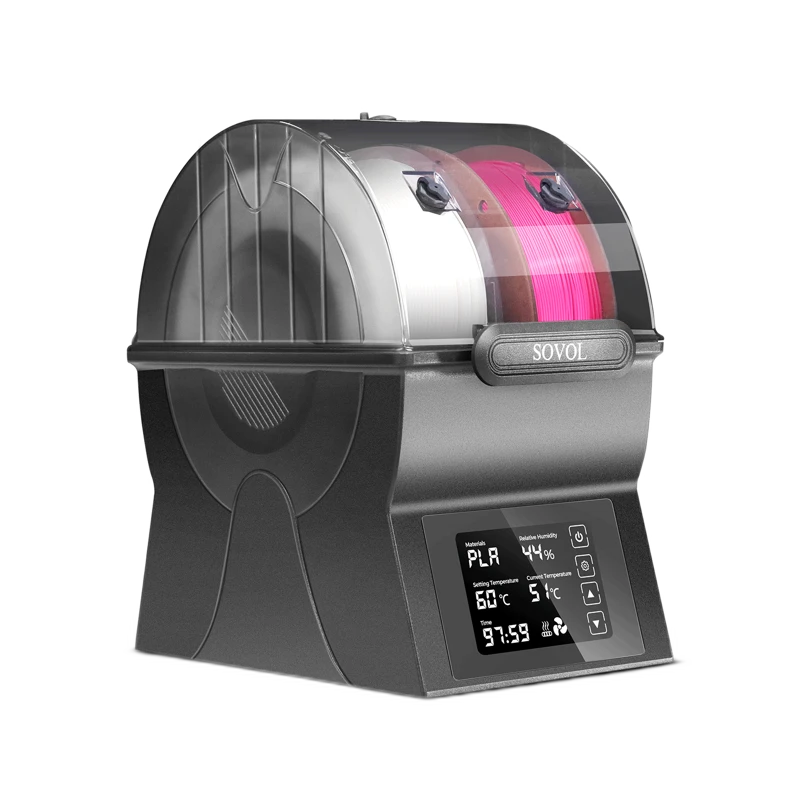
Sovol SH02

Creality SpacePi X4L
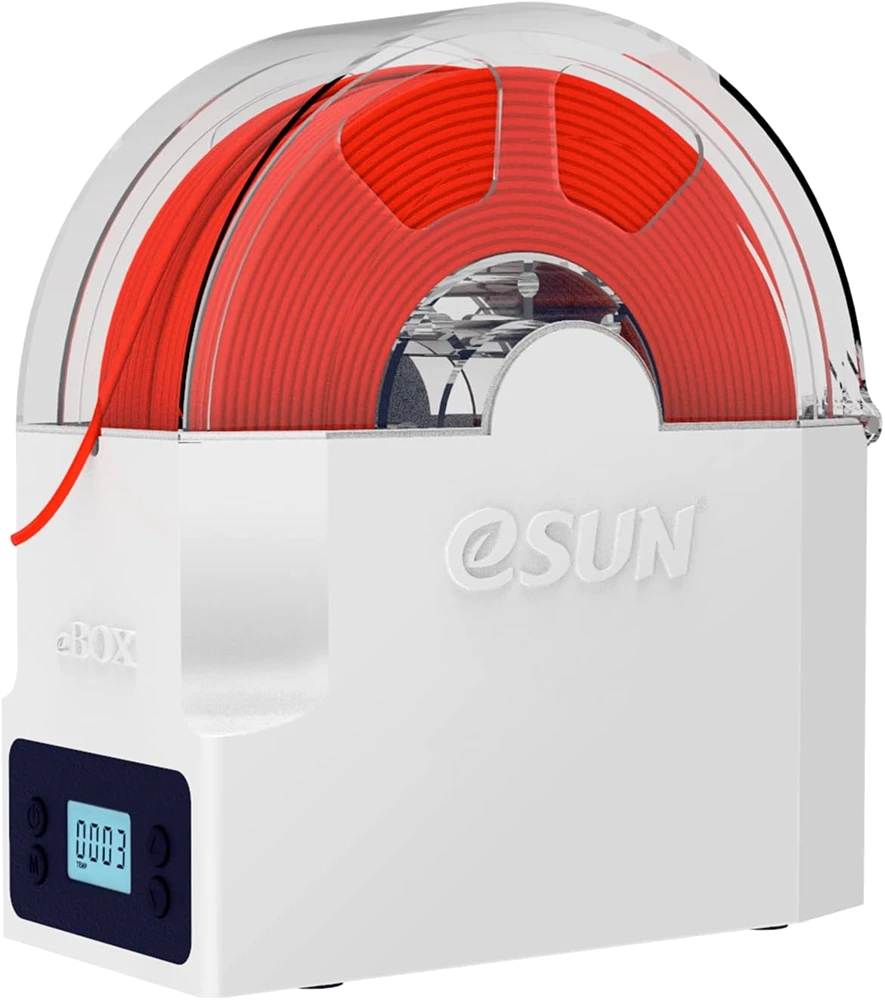
eSUN eBOX Lite
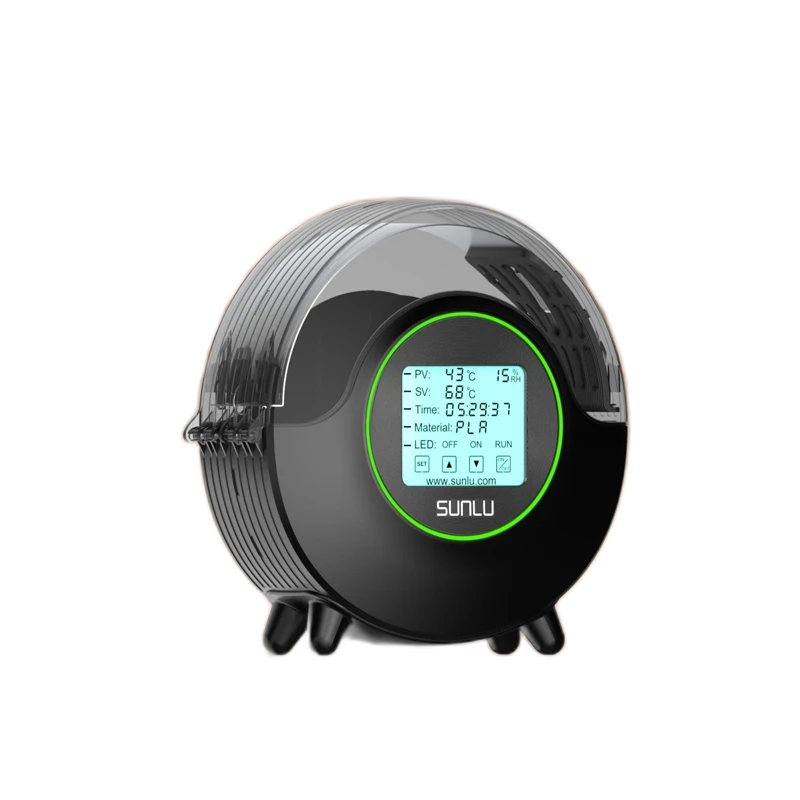
SUNLU FilaDryer S2