
Creality Space Pi V2 Plus review: a two-spool candidate with limited model-specific feedback
At a glance
The 75°C two-spool V2 Plus has one matching improvement report; pooled X4 comments do not establish this model’s feeding or reliability.
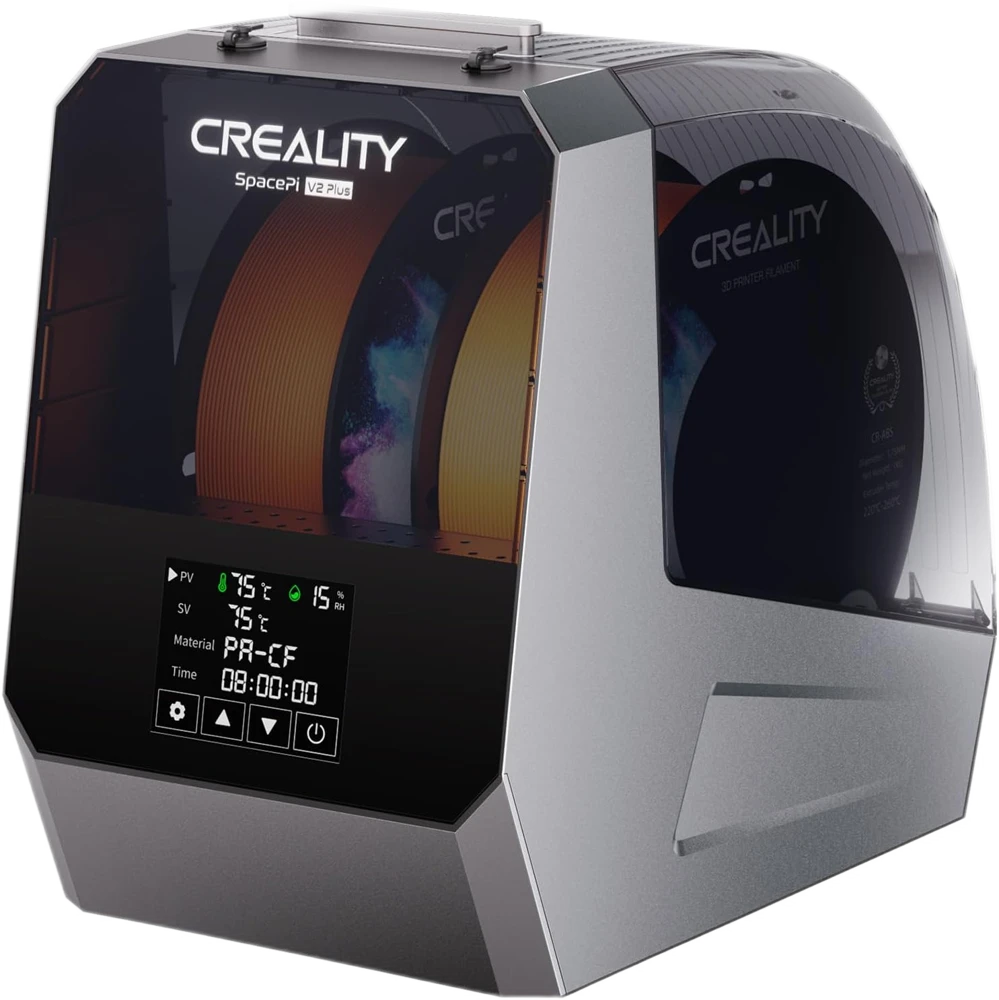
The setup
- Two-spool dryer
- 75°C maximum setting
- V2 Plus, not X4 or original Plus
Why consider it
- A matching use report describes a recovered printing job.
- The documented two-spool format suits paired preparation.
What to weigh up
- Most pooled comments concern a different dryer.
- Loaded performance and spool clearance still need qualification.
The Space Pi V2 Plus is the two-spool, 75°C model. Its Amazon page also contains X4 comments, so the distinction matters before evaluating either praise or complaints.
Keep the models separate
| Evidence | What it can support |
|---|---|
| Explicit V2 Plus account | A successful print after spool preparation. |
| X4 spool-jam complaint | Not a V2 Plus finding. |
| X4 capacity and storage praise | Not a V2 Plus benefit. |
Qualify the pair you actually use
Check both spool dimensions, the material maker’s drying guidance and the intended feed route. The documented temperature ceiling is useful only if it fits those requirements.
The matching success supports a cautious trial. It does not prove that a fixed four-hour cycle solves every stringing or adhesion problem.
What the controls add to a two-spool routine
- Power-loss memory: the listing says drying settings resume after an interruption. Check the restored state before relying on it.
- Long timer: the published upper duration is 448 hours. That is a control range, not a recommended drying cycle.
- Material presets: compare the preset with the exact filament and spool instructions; a familiar material name does not verify the supplied roll.
Pros & Cons Analysis
Based on supplied customer reviews and verified product documentation
Pros
- The selected model has a relevant positive example. After preparing the spool, a beginner completed a previously troublesome project. The account does not isolate moisture as the only variable or define a universal cycle.
- The design can fit a modest material routine. Two positions and a 75°C ceiling distinguish the V2 Plus from a single-spool box. Confirm the actual rolls and material requirements before buying.
Cons
- The evidence limit is model identity. The X4 accounts cannot establish V2 Plus feed behavior, reliability or faults. Do not use the listing’s broader discussion as if every comment describes this unit.
- The feature list does not settle the practical fit. The matching record does not establish even drying with both positions occupied or the clearance of unusual rolls. Check the current documentation and supplied hardware.
A candidate for two compatible rolls
Consider the V2 Plus when its documented temperature and two-spool format fit the routine. Keep the purchase conditional on actual spool clearance and a representative trial; X4 reviews should not decide it.
Frequently Asked Questions
Are the X4 jam reports evidence against this model?
No. X4 is a different dryer and those accounts are excluded from the V2 Plus assessment.
Is four hours the recommended cycle for every material?
No. That was one customer’s use. Follow the exact filament and spool guidance.
Technical Specifications
| Product type | Active filament dryer |
|---|---|
| Reviewed configuration | Creality Space Pi V2 Plus |
| Drying capacity | Two compatible spools per listing |
| Heat control | Maximum setting 75°C; touch controls and material presets; captured listing states power-loss setting memory and up to 448 hours. These are controls, not measured loaded performance. |
| Printing from the dryer | 1.75 mm / 2.85 mm per listing; qualify the outlet route and spool feeding before a long print |
| Humidity behavior | Air circulation: Heated airflow; revised duct per manufacturer; Sensors: Temperature and humidity feedback; chamber readings are not a direct measure of water inside filament |
| Fit and measurement basis | Important limit: Exact spool envelope and loaded uniformity not independently verified |
SUNLU AMS Heater
eSUN eBOX Lite
SUNLU FilaDryer S4
Polymaker PolyDryer