
PolyLite LW-PLA review: less weight without active foaming, but expect tuning
At a glance
A pre-foamed option for lightweight models and RC parts; stringing, seams and slow printing determine whether it suits your workflow.
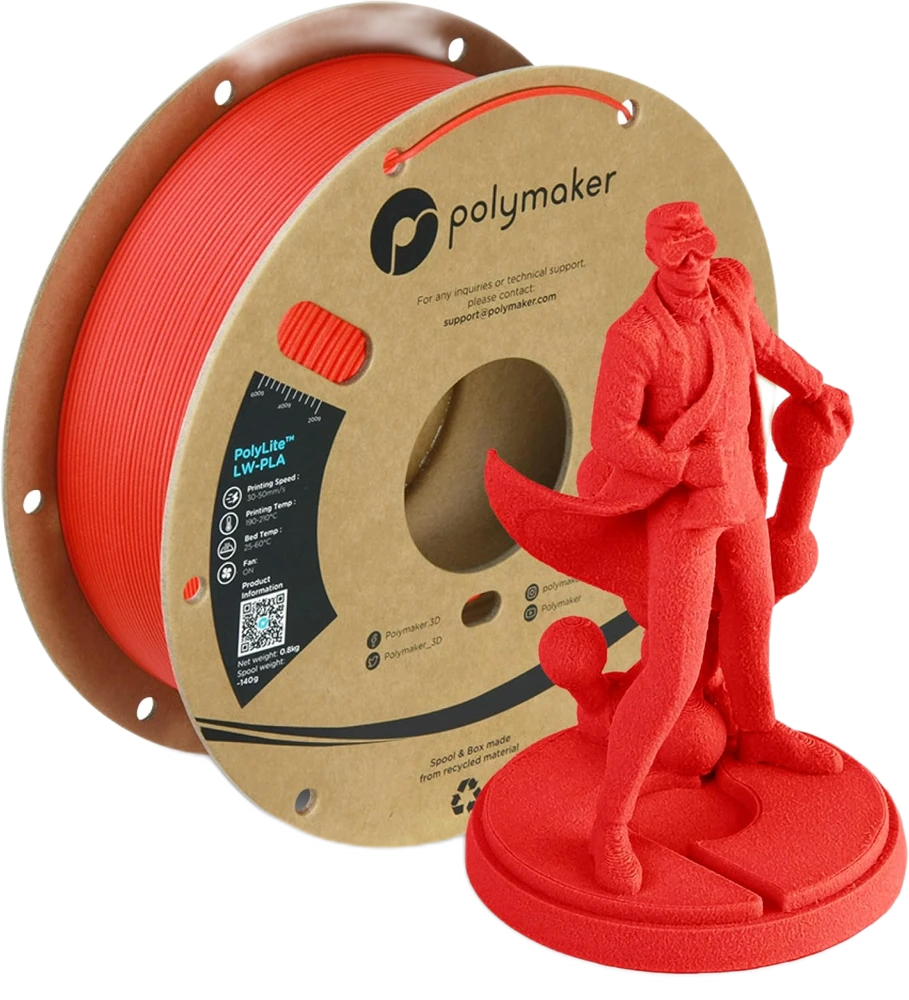
The material & format
- Pre-foamed during manufacturing
- Selected Bright Red, 1.75 mm, 0.8 kg spool
- Intended for weight-sensitive models; not a conventional one-kilogram offer
Why consider it
- A lightweight-model workflow without tuning an active foaming ratio.
- Good thin-wall results are possible after calibration.
What to weigh up
- Stringing and oozing can weaken a thin-wall seam.
- Slow printing and setup time can offset the convenience.
PolyLite LW-PLA answers a specific question: can you print a lightweight model without managing active foaming in the hotend? Polymaker foams this material during manufacturing. The remaining challenge is getting thin walls, travel moves and seams to behave.
Follow the seam, not just the surface
- Print a representative wall section. Include the seam and travel moves used by the real model.
- Inspect material loss during travel. Stringing is more consequential when it leaves a weak seam in a thin shell.
- Change one setting and record the result. A successful detailed account followed this approach after unfocused adjustments failed.
- Check the finished section before scaling up. A clean photograph alone does not validate a structural application.
Pre-foamed does not mean universally plug-and-play
| What it removes | What remains |
|---|---|
| An active-foaming ratio to manage during extrusion | Temperature, retraction and travel calibration |
| The need to create the foam in the hotend | Bed adhesion and seam checks on your geometry |
Feedback spans straightforward PLA-profile use, lengthy tuning and unresolved failures. The useful conclusion is conditional: this is a candidate for patient model builders, not a promise of ordinary high-speed PLA behavior. The selected roll contains 0.8 kg, so compare package value on that basis.
Before treating low weight as a speed advantage, identify the printer’s actual flow and motion bottleneck.
Plan the lightweight part before changing temperatures
PolyLite LW-PLA is pre-foamed. Its technical sheet lists a nominal density of 0.9 g/cm³ at 23°C; that characterizes the material, not a guaranteed weight reduction for your model. Compare finished mass at the same geometry and keep enough wall structure for the intended handling.
Pros & Cons Analysis
Based on supplied customer reviews and verified product documentation
Pros
- The material arrives pre-foamed. This removes the active-foaming step from the workflow. RC-plane experiences support the application, but do not establish a universal weight saving against another filament.
- Successful tuning can pay off in model parts. Aircraft feedback describes useful rigidity and layer bonding once settings were settled. Qualify your seam and geometry rather than transferring an owner’s strength impression to a flight-critical design.
Cons
- Travel behavior is part of the part quality. A detailed calibration account links material loss during travel to a weak seam; other users could not resolve adhesion and stringing. Keep the troublesome travel moves in your trial.
- Plan around the actual model workflow. Favorable results still describe slow printing and deliberate retraction adjustments. Some users prefer active-foaming alternatives, so pre-foamed does not automatically mean easier for every printer.
Prove one wing section before buying for the whole model
PolyLite LW-PLA is worth a trial if avoiding active foaming matters and you can spend time on thin-wall calibration. Its appeal weakens when fast setup or high throughput is the priority.
The seam is clean and the wall holds together
Repeat the section with the intended settings and inspect consistency before expanding the project.
Travel still leaves a weak seam
Do not scale up yet. Resolve material loss and adhesion, or compare another lightweight workflow.
Frequently Asked Questions
Does PolyLite LW-PLA expand in the nozzle?
Polymaker describes it as pre-foamed during manufacture, unlike active-foaming lightweight PLA.
Is the selected spool one kilogram?
No. The captured Bright Red offer contains 0.8 kg. Compare package quantities before judging value.
Technical Specifications
| Product type | PLA-based filament |
|---|---|
| Reviewed formulation | PolyLite LW-PLA; pre-foamed PLA; selected Bright Red |
| Nominal filament diameter | 1.75 mm |
| Manufacturer diameter tolerance | Not verified for this exact formulation |
| Package format | 0.8 kg spool |
| Nozzle guidance | Manufacturer starting range: 190–210°C nozzle; 25–60°C bed. Match the printer and build surface. |
| Material care | Manufacturer drying guidance: 55°C for 6 hours; verify the supplied spool tolerates the cycle, then store dry. |
| Variant / handling limit | Pre-foamed during manufacturing, not active-foaming PLA; no validated density comparison here |

Polymaker Matte PLA
SUNLU PLA

Bambu Lab PLA Matte

eSUN PLA+