
Polymaker HT-PLA review: a matte finish with a load-dependent heat story
At a glance
A convincing matte finish and conditional warm-location usefulness; layer strength and loaded heat performance need separate checks.
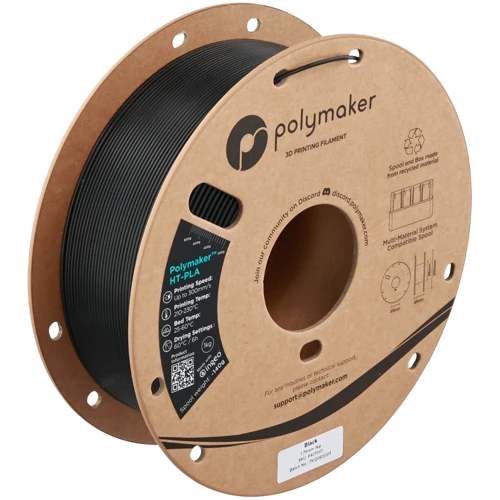
The material & format
- Standard HT-PLA formulation without glass-fiber reinforcement.
- Selected 1.75 mm, one-kilogram black roll.
- Heat stability specified under the part’s own weight.
Why consider it
- Matte surfaces can make layer lines less conspicuous.
- Successful printing is possible on ordinary PLA-capable machines.
- Useful warm-location results support carefully chosen, lightly loaded parts.
What to weigh up
- The heat headline does not establish loaded-part performance.
- Brittleness and layer separation limit confidence in thin functional features.
- Some setups need substantial work on adhesion or extrusion.
- Reel damage and snags can interrupt automatic feeding.
Polymaker HT-PLA is most interesting when you want a matte PLA-like print that may hold its shape better in a warm location. It is much less convincing as a shortcut to a strong, heat-loaded bracket. The letters HT describe a thermal feature; they do not settle layer strength, impact resistance or the design of your part. Our strength, stiffness and toughness guide separates those mechanical questions.
Read the heat claim with the load attached
Polymaker describes stability up to 150°C under the part’s own weight. That is not a 150°C working-load rating. The V1.1 technical sheet lists as-printed heat-deflection values of 58.6°C at 1.8 MPa and 61.4°C at 0.45 MPa. These are test-specimen values, not a guarantee for your geometry.
This distinction makes sense of the mixed practical feedback. Some warm-location parts stay useful, including desiccant containers and vehicle accessories. Other pieces deform in a car, and thin or loaded features can disappoint. A successful object in somebody else’s vehicle does not validate your clip, its stress or its exposure.
| Your intended job | How HT-PLA fits |
|---|---|
| A matte display piece | The finish is a credible reason to consider it, even before heat performance enters the decision. |
| A lightly loaded item near warmth | A candidate for checking the actual part and conditions; keep the thermal claim conditional. |
| A spring clip, thin tab or impact-prone part | Layer and breakage complaints deserve more weight than the attractive surface. |
| A permanently exposed outdoor fixture | Heat stability does not establish UV resistance or weathering life. |
The finish is the easier benefit to recommend
Matte black and grey surfaces, less obvious layer lines and clean-looking objects are recurring strengths. Orange has also been appreciated for a clay-like appearance. If you dislike a glossy finish, this is a more concrete reason to try HT-PLA than an unqualified promise of engineering performance.
Successful printing spans familiar machines and ordinary PLA-style setups. That lowers the entry barrier for a trial. It does not eliminate calibration: other experiences include lifting corners, inconsistent extrusion and clogs. A saved generic profile can be convenient when it works, but the actual first print remains the deciding check.
A good-looking surface can hide a weak part
Appearance can conceal weakness
The most consequential criticism is separation or breakage despite acceptable appearance. Thin tabs, layer bonds and dropped objects expose weaknesses that a smooth wall does not reveal. Treat that as a different question from bed adhesion. A part can stay attached to the plate and still be unsuitable for its intended load.
Check the functional feature
For an indoor decorative object, that tradeoff may be acceptable. For a functional fitting, inspect the important feature on a representative prototype before committing the complete assembly. Do not select this material for a critical load simply because it survives warmth without visibly sagging.
Separate three checks before a long job
Reel feedback includes both orderly winding and interruptions. A revised complaint even withdrew certainty about a factory tangle after the problem was cleared. Inspect the spool you receive without treating every stoppage as either a manufacturing defect or a temperature fault.
Keep HT-PLA, GF and Pro separate
This review concerns standard HT-PLA, selected as the black one-kilogram roll. HT-PLA-GF and HT-PLA Pro are different formulations. Their reinforcement or toughness claims cannot fill gaps in this material’s performance.
The current product instructions list a 210–230°C nozzle and 25–60°C bed. The page contains conflicting drying entries, so match the supplied roll’s current documentation before drying it. Annealing is a separate post-print operation; do not substitute a customer’s oven experiment for the applicable instructions.
Polymaker’s material explanation also says it has not been modified for UV or weather resistance. A short successful outdoor experience therefore supports that particular use, not a general outdoor-service claim.
Pros & Cons Analysis
Based on supplied customer reviews and verified product documentation
Pros
- Appearance has value independently of heat. The low-sheen finish gives visible parts a consistent look and can make layers less intrusive. Choose a printed color sample when appearance matters; the same surface description does not guarantee identical sheen across colors.
- A trial need not require an engineering-material workflow. Successful output on familiar machines shows that the material can fit an ordinary PLA setup. Start with the supplied instructions and a small relevant part; success with a stock profile is possible, not universal.
- There are practical successes near warmth. Useful containers and accessories show why this formulation attracts interest beyond decoration. Keep the benefit tied to the actual geometry and exposure, because loaded and thin parts also appear among the failures.
Cons
- Heat stability is narrower than a working-temperature rating. A part holding its own shape is different from supporting another object or remaining under stress. The contrary vehicle experiences make that distinction a buying issue, not a footnote.
- A polished print may still break at its layers. Reports of snapped tabs and weak bonds challenge an automatic choice for functional fittings. Appearance alone cannot qualify impact resistance or a stressed feature.
- Easy printing is not consistent across setups. Lifting, clogs and difficult extrusion appear alongside clean results. The small-nozzle complaint and modified-hardware examples should not become a claim that every machine fails, but they justify a modest first trial.
- The spool deserves a separate inspection. Bent cardboard and feeding interruptions can spoil a job after printing has started well. Other winding experiences are favorable, and the cause of a snag is not always clear; check the received reel and approved feeder route.
Start with the part’s load, then decide on HT-PLA
The matte finish is the straightforward attraction. Warm-location performance is the conditional one. Choose HT-PLA when both fit the actual part, rather than letting a high temperature headline decide for you.
My priority is a clean, low-sheen object
A small roll trial is reasonable. Check your chosen color and the supported or thin details that matter to the finished object.
The part will carry force while warm
Do not use the own-weight claim as its design rating. Establish the load and environment first, then choose a material with suitable documented performance.
I want a permanent outdoor fitting
Include weathering and UV requirements in the material choice. This formulation’s heat feature does not settle those requirements.
Frequently Asked Questions
Is standard HT-PLA rated to carry a load at 150°C?
No. The stated heat-stability claim concerns the part’s own weight. The technical sheet reports much lower as-printed heat-deflection values under its specified loads.
Is the matte finish proof of strength?
No. Surface quality and mechanical suitability need separate checks, especially for thin tabs, layer bonds and impact-prone parts.
Does heat stability make HT-PLA an outdoor material?
Not by itself. Polymaker says this formulation has not been modified for UV or weather resistance; a successful short-term outdoor use does not establish its service life.
Technical Specifications
| Product type | PLA-based filament |
|---|---|
| Reviewed formulation | Polymaker HT-PLA; unfilled formulation, not HT-PLA-GF or HT-PLA Pro |
| Nominal filament diameter | 1.75 mm |
| Manufacturer diameter tolerance | Not verified — no exact-variant tolerance adopted in this review |
| Package format | Selected Black #070707, 1 kg spool |
| Nozzle guidance | 210–230°C nozzle; 25–60°C bed |
| Material care | Drying instructions conflict on the store page; verify supplied-roll guidance. V1.1 TDS lists 60°C for 6 h. |
| Variant / handling limit | Heat stability under own weight is not a working-load rating; colors and GF/Pro formulations are separate |

PolyLite CosPLA Version A

Overture Easy PLA

Bambu Lab PLA Matte

PolyMax PLA