
SUNLU PETG-CF review: a strong finish argument, with a diameter warning
At a glance
The matte surface is well supported by matched feedback, but a serious thin-filament report deserves attention before long prints.

The material & format
- Selected black 1 kg PETG-CF.
- Manufacturer specifies 10% carbon-fiber filling.
- Published nozzle/bed guidance: 240–250°C / 50–70°C.
Why consider it
- Attractive matte finish in multiple matched accounts.
- Successful Bambu use with appropriate hardware and profile choices.
What to weigh up
- A detailed account reports a thin filament section and failed job.
- The customer results do not quantify extra strength or feeder wear.
SUNLU PETG-CF has a clearer argument for a matte surface than for a quantified strength increase. Matched black feedback describes attractive parts and workable support removal. An upgraded-nozzle A1 mini example explicitly leaves the strength comparison unresolved.
A switch in the middle of a job revealed both sides
A mid-job switch to SUNLU completed the print with a surface the user preferred.
The full reprint failed; a section of filament was reportedly too thin for reliable extrusion.
The diameter measurement is an owner observation, not a verified production measurement. Liking one finished part did not establish consistency throughout that reel.
What would make you switch?
A more matte visible surface
A relevant reason to compare a finished part with your current PETG-CF.
Reusing a familiar Bambu profile
Some successful experiences, alongside an account that changed temperature; not guaranteed interchangeability.
Greater strength than ordinary PETG
No measured improvement established by these prints.
When a feeding change is not a tuning exercise
If a previously steady job develops under-extrusion, inspect the material and route before compensating with more flow. Keep evidence of an apparent diameter fault for the supplier. An isolated report cannot establish a batch defect rate, but it should not disappear from a finish-led recommendation.
Pros & Cons Analysis
Based on supplied customer reviews and verified product documentation
Pros
- The surface can justify trying the filled material. Clean matte parts and manageable support removal are described on actual projects. Judge that benefit on the visible geometry you intend to print rather than assuming the carbon-fiber name guarantees an engineering upgrade.
- A familiar printer workflow may be usable. The Bambu examples include generic PETG-CF profiles, temperature adjustment and drying. They support a trial with compatible hardware, not universal automatic settings.
Cons
- One good print does not inspect the remaining spool. The adverse report found an apparently thin section only after a failed long job. It does not establish a defect rate, but it is material contrary evidence when planning time-sensitive work.
- Hardware compatibility still has to be established. An upgraded nozzle and successful AMS use are specific configurations. Check the printer manufacturer’s filled-filament restrictions instead of treating those accounts as a lifetime wear guarantee.
Try it for the surface, qualify it for the job
Consider it for the matte result, with a contingency for important jobs. A compatible nozzle and a good-looking part are worthwhile starting points. For a long deadline-driven print, retain a known-working material rather than assuming a favorable profile match proves the entire reel.
Frequently Asked Questions
Does this review establish the thin-section defect is common?
No. It preserves a serious matched report without converting one experience into a batch failure rate.
Is it proven stronger than regular PETG?
No controlled comparison appears in this customer evidence. The clearest supported advantage is the finish.
Technical Specifications
| Product type | Carbon-fiber-filled PETG |
|---|---|
| Reviewed formulation | SUNLU PETG-CF; manufacturer states 10% carbon fiber |
| Nominal filament diameter | 1.75 mm; manufacturer tolerance ±0.02 mm |
| Manufacturer diameter tolerance | Not verified for the selected offer |
| Package format | Black 1 kg |
| Nozzle guidance | 240–250°C at ≤150 mm/s published guidance; verify compatible nozzle; bed: 50–70°C |
| Material care | Exact drying cycle not verified on cited page; follow supplied instructions |
| Variant / handling limit | Check filled-filament restrictions for exact printer/feeder |
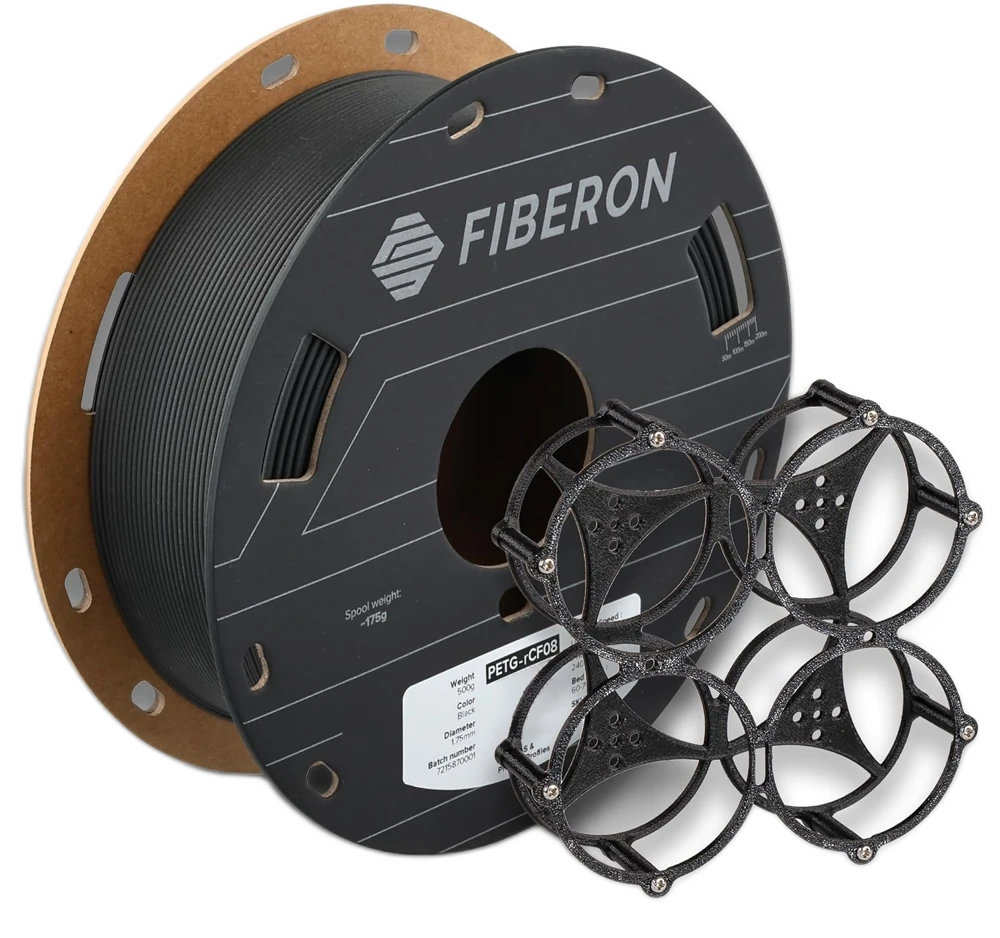
Fiberon PETG-rCF08

Bambu Lab PETG HF

Polymaker PETG

ELEGOO Rapid PETG