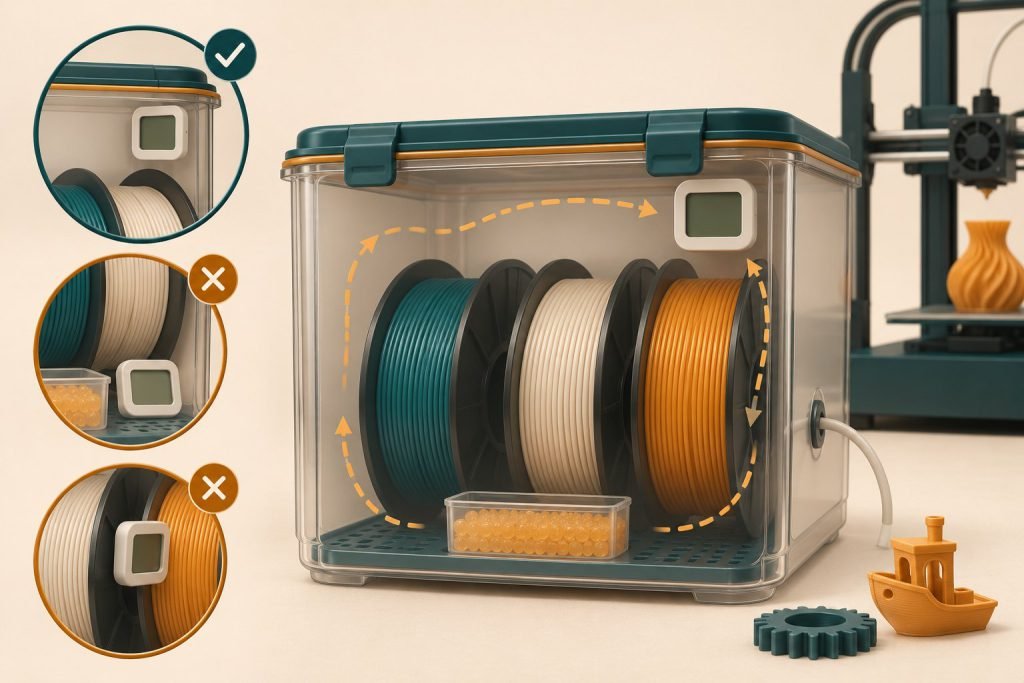
Put the hygrometer where its sensing openings are exposed to the box’s air and the display can be read without opening the lid. Avoid burying it under a spool or pressing its vents against a wall.
A useful placement has three clearances
- Air: the sensing openings remain uncovered.
- Movement: the spool and filament cannot catch the instrument.
- Heat: nearby electronics or a warm surface do not heat the sensor more than the surrounding air.
Silicon Labs’ humidity-sensor design guide explains why exposure to ambient air and isolation from local heat matter. It concerns sensor design, not a certified mounting position for every consumer hygrometer.
| Tempting position | Problem to check |
|---|---|
| Against the desiccant cartridge | Blocked openings or an unusually local reading |
| Under the spool | Hidden display, contact and rotating parts |
| Near a heater outlet | Temperature different from the stored spool area |
| Inside a sealed display pocket | Whether the sensor can actually sample the box air |
Two hygrometers disagree—what now?
Compare them side by side at the same temperature, after allowing the response time specified by their makers. Check stated accuracy and low-humidity limits before calling one defective. Agreement is not the same as calibration.
Read a trend, not just one number
Note the temperature, lid openings and desiccant changes alongside humidity. A reading immediately after loading the box is not directly comparable with an undisturbed overnight reading.
For a heated chamber, use the dryer humidity checks. A storage hygrometer is not automatically rated for dryer temperatures, and its display cannot tell you the filament’s internal water content.