
SUNLU S1 Plus review: choose the material before the dryer
At a glance
A compact first dryer for one compatible spool; the 55°C ceiling and feed route decide whether it fits your routine.
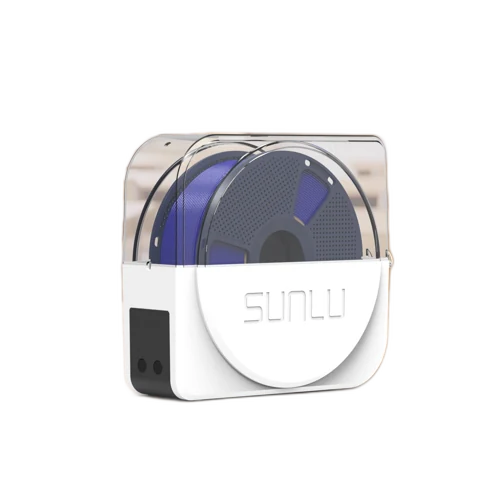
The setup
- Single-spool preparation with a circulation fan.
- Two-button temperature and time adjustment.
- Chamber humidity monitoring.
- Feed outlet for use beside a printer.
Why consider it
- Useful PLA and TPU improvements in suitable setups.
- Small single-spool format suits a modest collection.
- Can keep the spool in place while feeding the printer.
What to weigh up
- 55°C may limit material choice and turnaround.
- Two-button settings can take practice.
- Outlet placement can complicate the feed path.
- Fan noise and operating faults appear in the feedback.
The SUNLU FilaDryer S1 Plus is a reasonable first dryer when you use one spool at a time and your material’s drying instructions fit its 35–55°C range. Its appeal is a small, uncomplicated piece of equipment that can improve a familiar printing routine. Its limitation is equally plain: buying a low-temperature dryer cheaply does not help if your next material needs a hotter cycle.
Choose the material before the machine. This model has successful PLA, TPU and PETG experiences behind it, but PETG feedback ranges from useful improvement to slow or disappointing results. A good outcome with one formulation does not settle the requirements of another.
The Plus version has a fan; the review history goes further back
SUNLU’s current S1 Plus documentation identifies a built-in circulation fan and humidity display. The Amazon history includes older S1 units, including accounts that explicitly describe a fanless box. Those older hardware descriptions should not be used to explain the current model.
The distinction is visible in more recent experience: buyers describe a working fan and note that earlier no-fan complaints did not match what arrived. Check the exact product name and supplied manual, especially when buying used stock. This review does not treat every historical S1 fault as a confirmed fault of today’s S1 Plus.
A sensible fit for one established material
The strongest case is a routine built around ordinary single-spool jobs. Improved PLA results, cleaner TPU printing and reduced stringing support using the box when moisture is a plausible cause of a changed print. A compact footprint also makes more sense for a small material collection than paying for empty extra slots.
What you print
One familiar PLA or compatible TPU
Decision to make: Match the exact drying instructions to the temperature range and check spool fit.
Mostly PETG
Decision to make: Do not assume the 55°C ceiling is enough for your formulation and turnaround time. Successful results coexist with long waits and inadequate recovery.
Materials requiring hotter drying
Decision to make: Select suitable equipment from the start rather than relying on an extended low-temperature cycle as an equivalent.
Several rolls needed in quick succession
Decision to make: Account for the queue: a single chamber can become the limiting step even if each cycle works.
There is no sound basis here for promising a universal six-hour rescue. Nor should a towel wrapped around the machine or a disconnected fan become part of the buying recommendation. Those changes appear in customer accounts, but they alter how the heater operates and are not a substitute for equipment with the required operating range.
Simple hardware, less obvious controls
Two physical buttons keep the front panel uncluttered. Some users quickly settle into a repeatable routine and appreciate starting the same cycle without a more elaborate interface. Others struggle to distinguish changing a value from switching between settings, especially with minimal instructions.
The practical question is how often you change the cycle. Repeating one setup can make the controls a minor inconvenience. Frequently moving between materials makes the learning curve more noticeable. Check the displayed time and temperature after adjustment rather than assuming the last button press did what you intended.
The current S1 Plus user guide specifies a 1–99-hour timer. The older S1 manual attached to the Amazon listing specifies 0–24 hours, which explains why the listing history contains different limits. Match the supplied model and manual before planning a long print; the longer timer does not raise the 55°C temperature ceiling.
Give the filament path as much space as the box
Successful print-through use is a real benefit: the spool can stay in the dryer instead of being moved after preparation. Recent accounts describe low-resistance rolling, and the current design is intended to dispense filament while operating.
But a small enclosure does not guarantee a small overall installation. The outlet angle may force a sharp bend toward the printer or feeder. One otherwise positive experience ends in a return because the route to an AMS Lite binds. Other accounts describe lid movement, difficult spool changes or a light box being pulled when the path resists.
A route that needs drilling, a forced bend or disabling a component to work is a reason to reconsider the installation. The purchase should solve a printing problem, not create a new mechanical one.
Judge drying by the job, not one humidity reading
The humidity display can help monitor chamber conditions, but it does not measure the water inside the filament. Our humidity-display guide explains what to check when the reading seems stuck. A complaint based only on a particular RH number does not establish ineffective drying, just as a lower number does not prove the whole spool is ready.
More relevant evidence includes changed print quality, persistent popping after treatment, or a material that requires a temperature beyond the machine’s range. Keep the material instructions and a repeatable print check central to the decision.
Fan-equipped units receive both quiet-operation praise and complaints about noise. Failure and unexpected-shutdown accounts also exist, alongside continued successful use. These justify checking operation during the return period; they do not establish a product-wide failure rate. Stop using a malfunctioning heater and contact support rather than repeatedly restarting it as a routine workaround.
Pros & Cons Analysis
Based on supplied customer reviews and verified product documentation
Pros
- Preparation can rescue a familiar printing routine. Cleaner PLA and TPU results support drying when moisture plausibly explains a change in output. A successful formulation is a better starting point than a generic list of supported plastics; not every damaged or poorly printing roll will recover.
- A small collection does not need unused capacity. The enclosure is easier to place beside a hobby printer than a multi-spool station. Include adapter and routing space in that comparison, and allow for the queue if you regularly change rolls.
- Less transfer between drying and use. Successful feeding lets a compatible roll stay inside during a job. Confirm free rotation with the lid closed and a gentle path to the extruder; several contrary experiences concern the route rather than drying itself.
Cons
- The temperature ceiling sets the purchase boundary. PETG feedback includes useful results as well as slow or inadequate treatment. Extra time at a lower temperature is not automatically equivalent to the formulation’s specified cycle, particularly if you plan to add more demanding materials.
- Simple controls are not always intuitive controls. Repeating one familiar cycle can be convenient. Moving between settings is more frustrating for people who struggle with the two-button sequence, so check the resulting time and temperature rather than relying on an assumed input.
- The box may fit where the filament path does not. Sharp outlet angles, lid movement and a light enclosure can interfere with feeding. An otherwise satisfactory setup can still be unsuitable beside an AMS lite or a particular extruder position.
- Quiet operation is not universal. Current fan-equipped accounts include noise complaints and faults alongside successful use. Inspect operation early and stop using a malfunctioning unit; historical fanless S1 experiences are not a sound basis for scoring the current fan design.
A first dryer for a known material, with room to outgrow it
Choose S1 Plus when one compatible roll and a modest bench setup describe your actual routine. Its small size is useful; its low temperature ceiling is the reason to think ahead.
I mostly use one familiar PLA or TPU
Confirm the formulation’s instructions and reel dimensions. A repeatable cycle and a tested feed path make the strongest case for this model.
I am moving into hotter-drying materials
Choose around those requirements now. A longer timer cannot remove the temperature limit.
I change several rolls every day
Calculate the drying queue before buying. More capacity may matter more than saving space on the enclosure.
Frequently Asked Questions
Is the S1 Plus the same as the older S1?
No. Current S1 Plus documentation includes a fan, while the listing history also contains fanless S1 experiences. Check the supplied model and manual.
Is it enough for PETG?
Only if the exact formulation’s drying instructions and your turnaround needs fit the operating range. Customer outcomes include both successful treatment and disappointing results.
Does a low humidity reading mean drying is finished?
No. The display measures chamber air, not water inside the filament. Follow the material instructions and check the resulting print.
Technical Specifications
| Product type | Standalone filament dryer |
|---|---|
| Reviewed configuration | Current S1 Plus with circulation fan; historical fanless S1 excluded |
| Drying capacity | One compatible spool |
| Heat control | 35–55°C; 48 W rated; current S1 Plus guide: 1–99 h (older S1 manual: 0–24 h) |
| Printing from the dryer | Supported; check outlet angle, spool rotation and extruder path |
| Humidity behavior | Chamber humidity display; not a filament moisture measurement |
| Fit and measurement basis | 271 × 100 × 237 mm enclosure; selected listing maximum spool 210 mm diameter × 85 mm width |
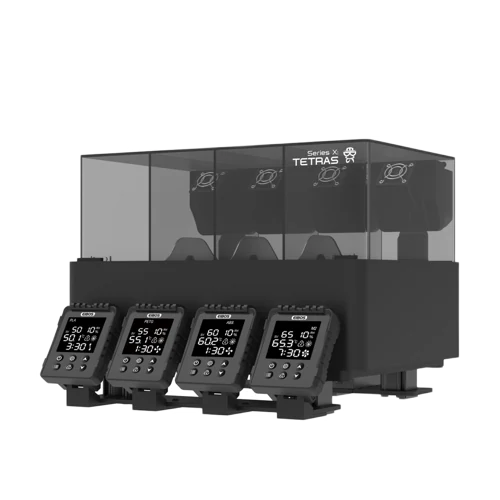
EIBOS Tetras

Creality SpacePi X4L
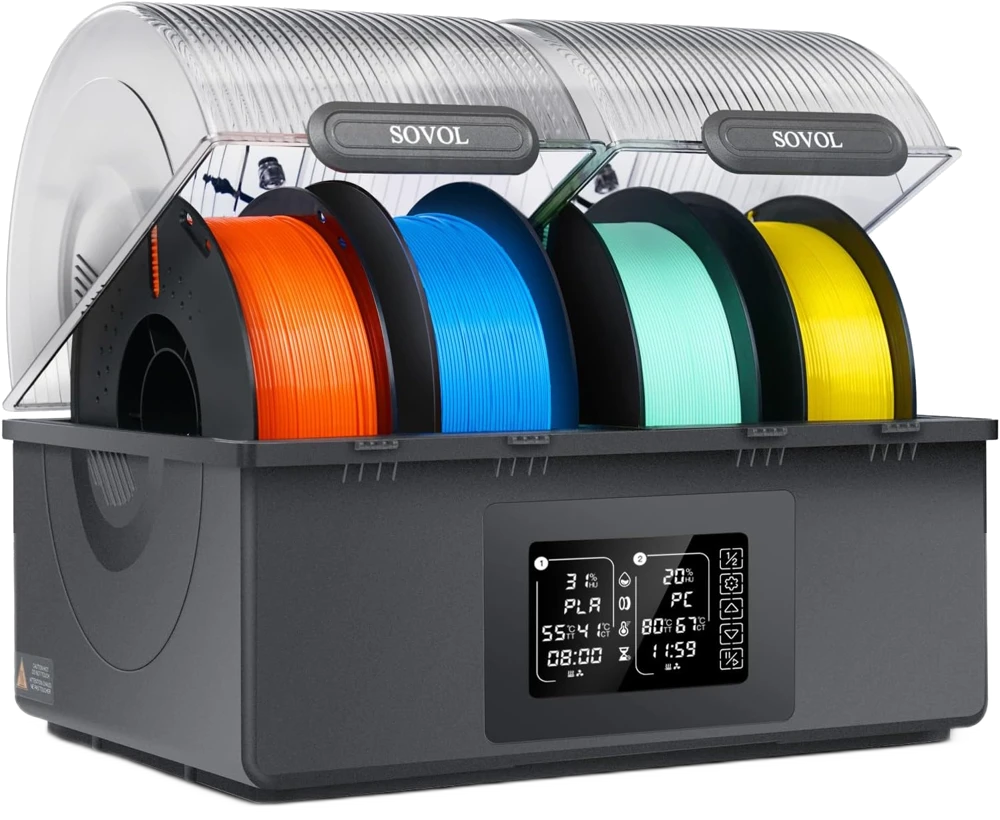
Sovol SH03
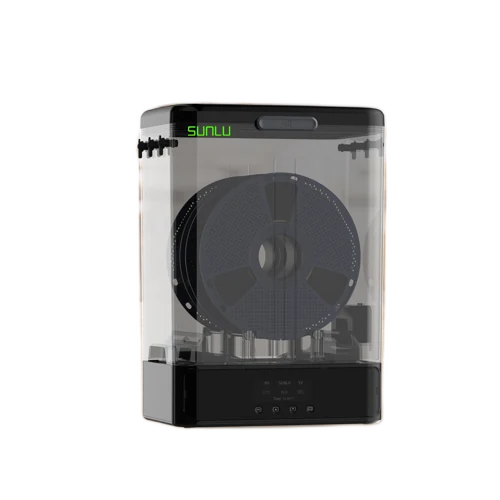
SUNLU SP2