Layer & BenchMATERIALS. TOOLS. BETTER PRINTS.
⇄ Compare products
DryingStoragePLA & PLA+PETGBuild platesNozzlesTPUNylonABS & ASA
ReviewsBuying guidesLearnComparisonsSaved ♡

SUNLU S4 vs E2: four-roll capacity or hotter preparation?

Choose between an ordinary multi-roll schedule and a documented higher-temperature material requirement.

Conceptual illustration for SUNLU S4 vs E2: four-roll capacity or hotter preparation?
The line-up

Compare the setups

Select a product to explore its fit and specifications.

Filament dryer

SUNLU FilaDryer S4

Four matching cycles
Check current price ↗ · Amazon View details ↓
Filament dryer

SUNLU FilaDryer E2

Higher-temperature prep
Check current price ↗ · Amazon View details ↓

These solve different queues

Four compatible ordinary rolls

S4 is the capacity-oriented choice when the rolls share a cycle within 70°C.

Fewer rolls needing more heat

E2 reaches a stated 110°C maximum and is relevant when the exact material instructions exceed ordinary dryer ranges.

Attribute S4 E2
Nominal arrangement Up to four 1 kg spools Two 1 kg rolls or one compatible larger reel
Maximum set temperature 70°C 110°C
Mixed temperatures at once No independent zones Not a two-independent-cycle substitute
Critical fit check Individual spool clearance across the shared chamber Large reel diameter, width and outlet alignment

Why E2 is not simply a more powerful S4

The E2’s higher-temperature role is supported by matched PA6-CF drying experiences. It also changes the loading and inspection task: users report both successful larger reels and reels that rub or do not fit. The current SUNLU E2 page describes its higher-temperature capability, but does not turn nominal reel mass into guaranteed feeding clearance.

Annealing is a separate requirement

Do not buy E2 on the assumption that an annealing label supplies a complete programmable process. Feedback describes awkward controls and the absence of a convenient ramp-and-controlled-cool workflow. Use the exact material’s post-processing procedure, and keep it separate from drying a spool.

My material says 100°C for drying

That requirement rules out the standard S4 for that cycle. E2 is the relevant candidate of this pair, but the spool and equipment instructions must also agree. A 100°C requirement does not justify heating an unsuitable spool.

If four rolls need two different cycles rather than hotter preparation, S4 versus S4 Pro is the more useful comparison.
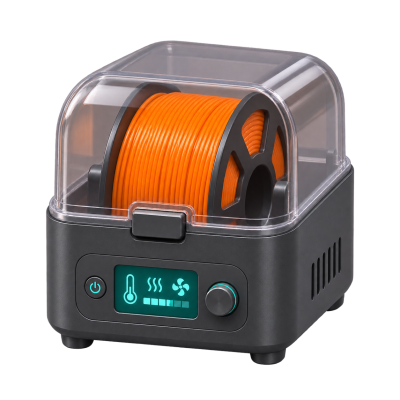
Filament dryerFour matching cycles
Product image: SUNLU FilaDryer S4↗
Product image

SUNLU FilaDryer S4

S4 is the queue-clearing option for four ordinary rolls on one approved cycle. That capacity can be more useful than extra heat when the materials stay within 70°C. It loses the comparison as soon as the specific required cycle exceeds that limit; more time is not an assumed substitute.

Capacity
Up to four 1 kg spools
Heat control
Up to 70°C; shared chamber
Filament feed
Supported; eight outlets

Setup notes

  • Reviewed configuration: S4 / S4-FD; standard four-spool unit
  • Drying capacity: Up to four 1 kg spools
  • Heat control: Up to 70°C; shared chamber

✓ Best if

  • You rotate several compatible rolls through the same temperature schedule.
  • You need a choice of outlet directions around a multi-printer bench.

− Skip if

  • You regularly mix materials that need different drying temperatures.
  • A material calls for more than its 70°C ceiling.
SpecificationsDrying & feedingExplore+
Product typeStandalone filament dryer
Reviewed configurationS4 / S4-FD; standard four-spool unit
Drying capacityUp to four 1 kg spools
Heat controlUp to 70°C; shared chamber
Printing from the dryerSupported; eight outlets
Humidity behaviorSelectable 30–50% RH start threshold; stops at 25% RH
Fit and measurement basis450 × 210 × 211 mm chamber, not a per-spool allowance
Read the full review →
Check current price ↗ · Amazon
Filament dryerHigher-temperature prep
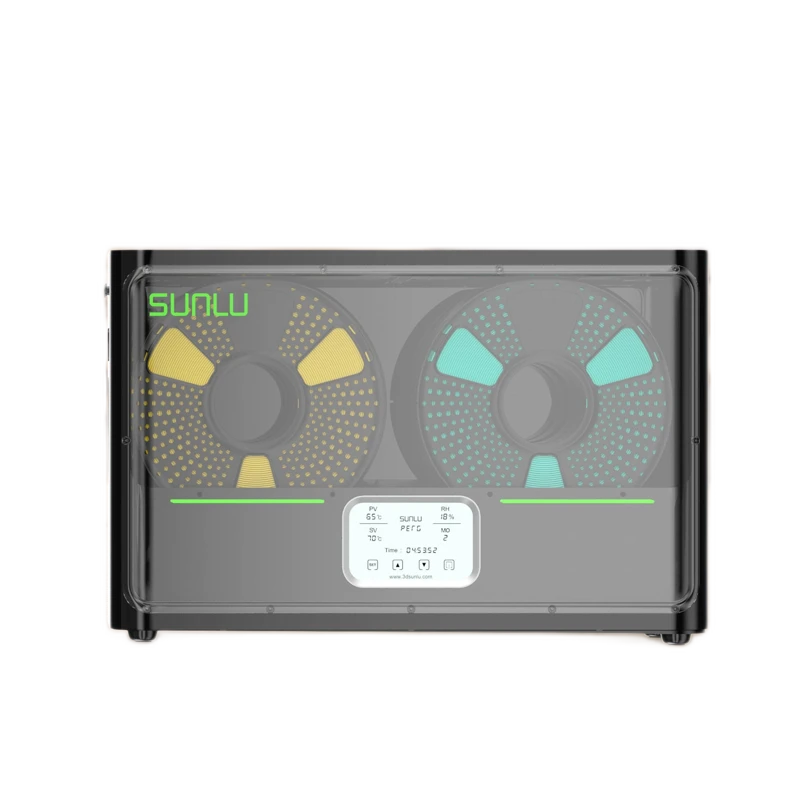
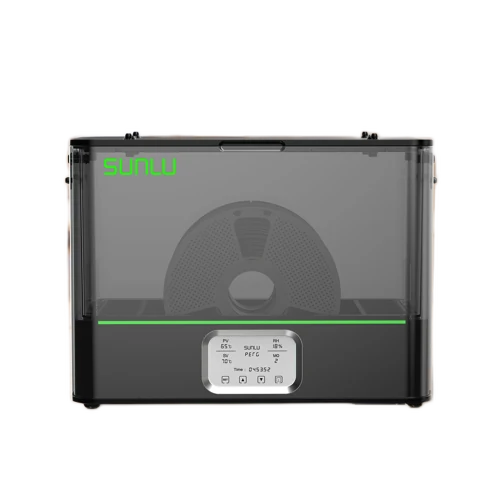
Product image: SUNLU FilaDryer E2↗
Product image

SUNLU FilaDryer E2

E2 trades the ordinary four-roll arrangement for higher-temperature capability and a different loading envelope. PA6-CF experiences support that role, but a nominal large-reel rating does not prevent rubbing or poor outlet alignment. Choose it for a verified thermal requirement, then qualify the actual reel.

Capacity
Current manual: two 1 kg rolls or one compatible 2–3 kg roll; fit and feed clearance must be checked
Heat control
Current manual: 35–110°C, 0–99 h; operating wattage unresolved: official page325W, store/listing500W PTC
Filament feed
Supported outlets; verify lateral alignment and free rotation for the actual spool

Setup notes

  • Reviewed configuration: E2 drying and annealing enclosure; current versus earlier hardware supply not resolved
  • Drying capacity: Current manual: two 1 kg rolls or one compatible 2–3 kg roll; fit and feed clearance must be checked
  • Heat control: Current manual: 35–110°C, 0–99 h; operating wattage unresolved: official page325W, store/listing500W PTC

✓ Best if

  • You have a verified higher-temperature drying requirement and a compatible heat-tolerant spool.

− Skip if

  • You mainly need four ordinary 1 kg rolls prepared together.
  • You expect a large reel to fit and feed solely because it weighs 3 kg.
  • You want unattended programmable ramp-and-cool annealing profiles.
SpecificationsDrying & feedingExplore+
Product typeStandalone filament dryer
Reviewed configurationE2 drying and annealing enclosure; current versus earlier hardware supply not resolved
Drying capacityCurrent manual: two 1 kg rolls or one compatible 2–3 kg roll; fit and feed clearance must be checked
Heat controlCurrent manual: 35–110°C, 0–99 h; operating wattage unresolved: official page325W, store/listing500W PTC
Printing from the dryerSupported outlets; verify lateral alignment and free rotation for the actual spool
Humidity behaviorCurrent manual:10–90% RH ±10%; protection display below10% at≥80°C; not filament moisture
Fit and measurement basisManual:400×220×307mm enclosure;372×192×255mm interior;250mm diameter×153mm spool envelope; supplied revision to confirm
Read the full review →
Check current price ↗ · Amazon

Product Comparison

Feature SUNLU FilaDryer S4 SUNLU FilaDryer E2
Product Image
SUNLU FilaDryer S4
SUNLU FilaDryer E2
Category Filament Dryers Filament Dryers
Product type Standalone filament dryer Standalone filament dryer
Reviewed configuration S4 / S4-FD; standard four-spool unit E2 drying and annealing enclosure; current versus earlier hardware supply not resolved
Drying capacity Up to four 1 kg spools Current manual: two 1 kg rolls or one compatible 2–3 kg roll; fit and feed clearance must be checked
Heat control Up to 70°C; shared chamber Current manual: 35–110°C, 0–99 h; operating wattage unresolved: official page325W, store/listing500W PTC
Printing from the dryer Supported; eight outlets Supported outlets; verify lateral alignment and free rotation for the actual spool
Humidity behavior Selectable 30–50% RH start threshold; stops at 25% RH Current manual:10–90% RH ±10%; protection display below10% at≥80°C; not filament moisture
Fit and measurement basis 450 × 210 × 211 mm chamber, not a per-spool allowance Manual:400×220×307mm enclosure;372×192×255mm interior;250mm diameter×153mm spool envelope; supplied revision to confirm
Details / retailer Check current price · Amazon Check current price · Amazon

Choose according to the next job waiting

Decide whether the bottleneck is four ordinary rolls or a hotter documented cycle.

Choose S4 when four suitable rolls are waiting for the same ordinary cycle. Choose E2 when a verified hotter cycle is the bottleneck and the reel fits with clearance. Keep an existing S4 for ordinary materials if E2 is being added for engineering grades; the two jobs need not be forced into one box.

Do I need to replace my S4 entirely?

Not if it still serves ordinary materials. A separate higher-temperature role can coexist with the shared four-roll routine.

Four matching cycles ↑Higher-temperature prep ↑

Frequently Asked Questions

Which model has a lower energy cost per roll?

That is not established here. A defensible comparison needs energy used for comparable completed jobs, including loading and cycle conditions. The devices’ different capacity and temperature roles make a simple power-label comparison inadequate.

×
Layer & Bench

Find the right materials and gear
for better 3D prints.

A RESEARCH-BASED PRINTING RESOURCE

Explore

DryingStoragePLA & PLA+PETGBuild platesNozzlesTPUNylonABS & ASA

Make a decision

Product reviewsBuying guidesModel comparisonsPractical guides

Behind the articles

Our approachEditorial disclosureContact & correctionsPrivacy
© Layer & Bench

As an Amazon Associate I earn from qualifying purchases.

Compare your shortlist ↗