
PolyDissolve S1 review: useful removable support, if the feed stays dependable
At a glance
Water-soluble interfaces can improve difficult supported surfaces; moisture, breakage and material pairing make it a workflow purchase.
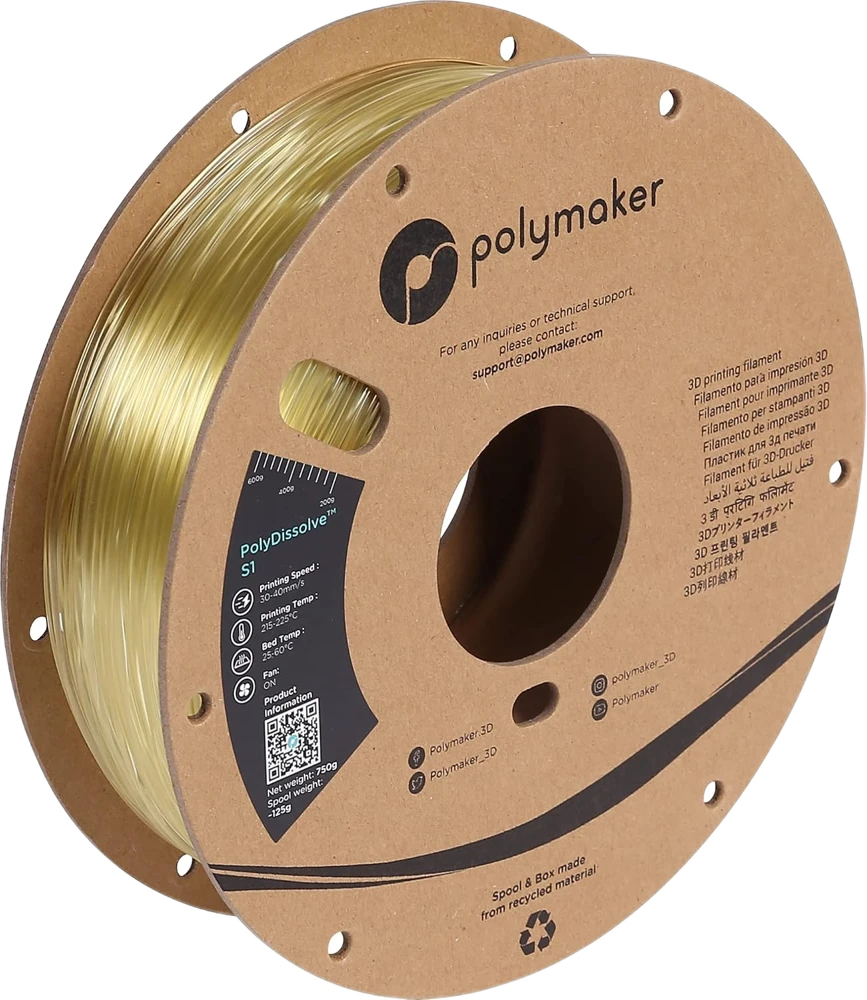
The setup
- PVA-based water-soluble support filament
- Selected 1.75 mm, 750 g
- Manufacturer lists PLA, TPU, PVB and nylon-based material pairing
Why consider it
- A way to remove support from difficult supported surfaces.
- Water removal can reduce mechanical cleanup.
What to weigh up
- Moisture and retraction can disrupt feeding.
- Pairing and slicer settings need an actual support trial.
- Not a universal support for every material.
PolyDissolve S1 is worth considering when removable support would solve a surface or access problem that ordinary breakaway material cannot. It is less convincing as an effortless upgrade: the support has to feed, adhere and remain intact for the whole job before water removal can help.
Test the interface, not just a PVA cube
- Use the intended model material. Start within the manufacturer’s listed pairing set.
- Include the real layer height and supported face. Fine-layer failures appear in the feedback.
- Run enough material changes to exercise feeding. A clean initial extrusion does not check retraction breakage.
- Complete the removal process. Judge the model surface after dissolving and cleaning.
Budget drying and dissolution time
Positive experiences describe effective removal, while negative ones report jams and inconsistent support deposition. The official catalog gives a typical dissolution window of 6–12 hours, with water movement and renewal affecting the process. Treat that as guidance rather than a deadline for every geometry.
If the model is nylon, the support-material compatibility checks matter more than PVA’s ability to dissolve by itself.
Pros & Cons Analysis
Based on supplied customer reviews and verified product documentation
Pros
- The benefit is the interface. Positive accounts describe useful close-contact support and removal after water exposure. This can matter where breakaway support damages the required surface.
- Complex access is a plausible use case. Successful experiences include dissolving and brushing remaining material away. Time depends on the support volume and process, so do not plan around one unusually fast account.
Cons
- The support must survive the whole print. Matching accounts describe brittle breaks and jams, sometimes improved by drying and sometimes persisting. A dry box alone is not proof of reliable long-job feeding.
- Extruding PVA is not enough. Accounts report poor interface adhesion, stringing and interrupted support structures. Validate the contact area and the model’s real layer height.
- Respect the listed pairing. Polymaker specifies PLA, TPU, PVB and nylon-based materials. A PETG failure and an isolated success with another engineering material should not broaden that list.
Buy the complete support workflow
Choose S1 when removable support solves a specific geometry problem and a small paired-material test succeeds. Keep moisture control, material changes and dissolution in the project schedule.
The supported face cleans up well
Repeat the test with the real job’s layer height and longer material-change sequence.
The support breaks or stops depositing
Resolve feeding and interface settings before scaling up; soluble support cannot help a structure that never finishes.
Frequently Asked Questions
How long will S1 take to dissolve?
The official catalog describes a typical 6–12-hour window. Support volume, water conditions and movement affect the result; individual reports are not a guarantee.
Is a single successful extrusion enough to approve the setup?
No. Test the paired interface, the real layer height and repeated material changes before the full model.
Technical Specifications
| Product type | Water-soluble support filament |
|---|---|
| Reviewed formulation | PolyDissolve S1 PVA-based support |
| Nominal filament diameter | 1.75 mm |
| Manufacturer diameter tolerance | Not verified for this exact formulation |
| Package format | 0.75 kg spool |
| Nozzle guidance | Manufacturer starting range: 215–225°C nozzle; 25–60°C bed. Match the printer and build surface. |
| Material care | Manufacturer drying guidance: 80°C for 12 hours; verify the supplied spool tolerates the cycle, then store dry. |
| Variant / handling limit | PETG is not included in the listed pairing set |

eSUN PVA