
eSUN PVA review: soluble supports only help if the spool feeds reliably
At a glance
Useful for difficult support geometry, but spool fit, moisture and the finished interface need separate checks.

The setup
- Water-soluble PVA support material
- Selected natural 500 g spool
- 1.75 mm diameter
Why consider it
- Supports can be removed from awkward geometry.
- A useful route for intricate multi-material work.
What to weigh up
- The supplied spool has caused feeder-fit problems.
- Preparation does not guarantee a clean interface.
- Inspect the strand as well as the spool fit.
PVA is useful when the support is harder to remove than the model is to print. eSUN’s 500 g spool has matching successes on complex geometry, but the full process includes feeding, printing and removal.
Three gates before a long supported print
- Feed the current spool. Check dimensions and your exact feeder’s material guidance. Historical narrow-spool complaints coexist with a current manufacturer compatibility claim.
- Print a representative interface. Include the small detail or enclosed feature that makes soluble support worthwhile.
- Finish removal and inspect. A softened, gel-like support is not the same as a clean finished cavity.
Where the payoff is strongest
A difficult cavity or delicate feature gives PVA a clear job. An easily accessible support on a simple part offers less benefit relative to the extra preparation and material changes. The matching evidence includes useful complex supports, but also rough interfaces and a clogged hotend.
Pros & Cons Analysis
Based on supplied customer reviews and verified product documentation
Pros
- The value is access. Matching feedback includes successful support for complex shapes and PLA-based jobs after preparation. Dissolution can address areas that are difficult to reach mechanically.
- Successful prints are documented. Complex-support feedback shows the material can serve its intended role. The supported surface still needs inspection rather than assuming a perfect interface.
Cons
- Check the package revision. Several accounts describe a narrow spool or resupply through another spool. The current manufacturer page advertises AMS compatibility, so historical fit problems should prompt a dimension check rather than a blanket current incompatibility claim.
- Support removal is only one stage. Matching feedback includes a clog, discoloration of a white part and roughness near fine supported detail. Qualify the model/support pairing before a long job.
- Uneven diameter was another reported feeding concern. A captured account describes visible bumps and varying measurements along the strand. That is not a calibrated tolerance test or a defect rate, but a visibly irregular roll deserves inspection before a long support job; drying alone would not establish dimensional consistency.
Prove the complete support cycle
Choose eSUN PVA for geometry that benefits from soluble removal. Proceed to the full model only after the current spool feeds, the interface prints and the support is completely removed from a small representative sample.
Frequently Asked Questions
Does ten minutes in water establish complete removal?
No. A matching account describes early softening, which does not prove a finished cavity is clear. Follow the current material instructions and inspect the result.
Why do older fit complaints matter if the current page says AMS compatible?
They identify a packaging check. Confirm the delivered spool dimensions and exact system guidance rather than assuming either historical or current packaging.
Technical Specifications
| Product type | Water-soluble support filament |
|---|---|
| Reviewed formulation | eSUN PVA; natural |
| Nominal filament diameter | 1.75 mm |
| Manufacturer diameter tolerance | Not verified for this exact formulation |
| Package format | 500 g spool |
| Nozzle guidance | Manufacturer starting range: 180–230°C nozzle; 45–60°C bed. Match the printer and build surface. |
| Material care | Manufacturer drying guidance: 45°C for more than 10 hours; verify the supplied spool tolerates the cycle, then store dry. |
| Variant / handling limit | Verify current spool dimensions and feeder material permission |
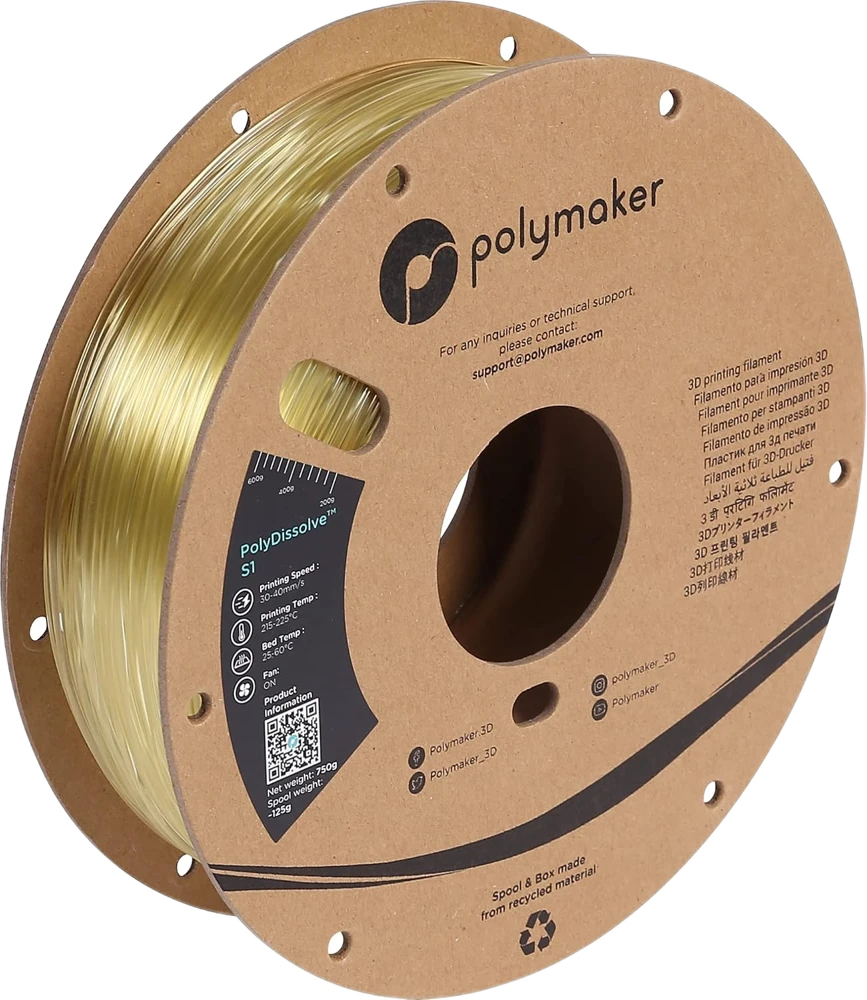
PolyDissolve S1