
PolyMax PC review: check the printer before the toughness claim
At a glance
A toughness-oriented PC candidate for prepared enclosed printing; matching customer evidence is limited to small-part and appearance results.
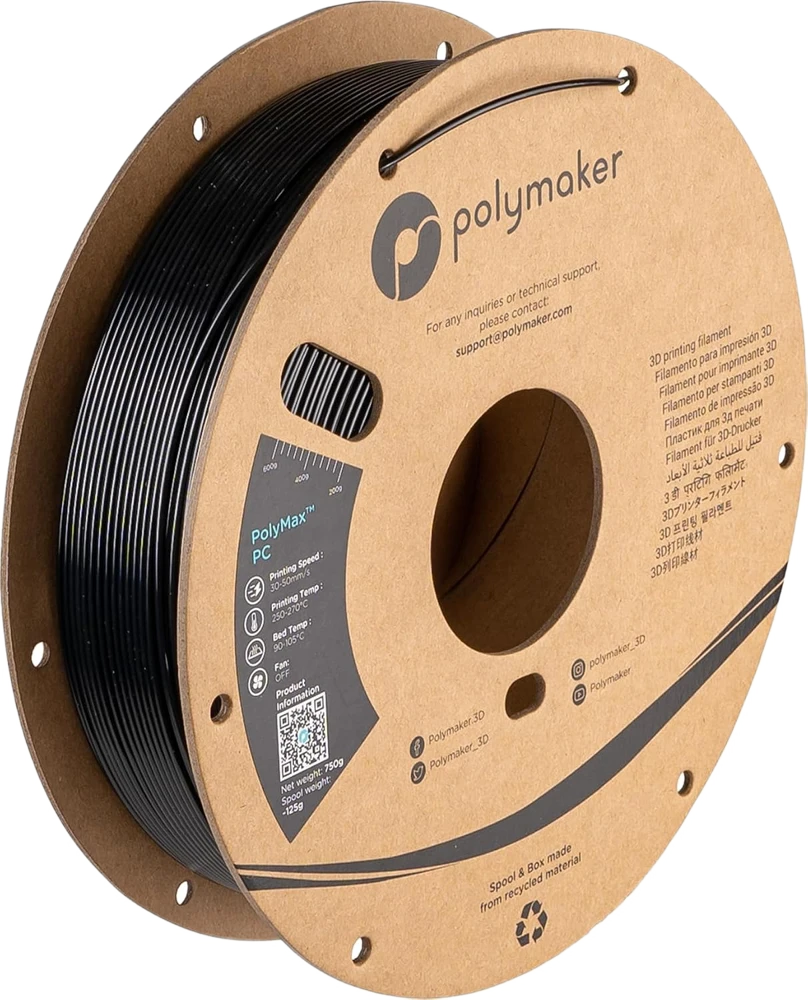
The setup
- PolyMax PC polycarbonate formulation
- Selected 0.75 kg black spool, 1.75 mm
- Enclosed-printer preparation recommended by manufacturer
Why consider it
- Encouraging results for small functional parts.
- Good appearance with a prepared heating setup.
What to weigh up
- Matching written evidence is narrow.
- Printer preparation and package size change the value calculation.
PolyMax PC is a purchase to make after checking the printer requirements. The manufacturer positions it around toughness and heat resistance, with enclosed printing especially important for large or dense objects. The exact black-offer feedback is encouraging but modest: small work parts printed successfully, and another account reports good appearance with proper heating.
Start with the application, then the spool
- Small enclosed-printer component: the matching feedback supports a trial, followed by a fit and function check.
- Large dense part: verify the enclosure and current printing requirements first.
- Defined heat or load exposure: obtain the relevant material data and qualify the design; the customer accounts do not establish an operating limit.
Why the shared rating needs context
The Amazon page pools several Polymaker PC formulations. The transparent PolyLite accounts and the detailed PC-PBT story are not evidence for black PolyMax. This assessment uses the two accounts whose variant links point to the selected black ASIN.
The limited matching reports do not settle long-term durability or difficult large-print behavior. Buy a trial quantity for a specific requirement rather than treating a pooled star score as a toughness benchmark.
Record the PolyMax formulation and opened date in your filament inventory before transferring a profile from another PC blend.
Pros & Cons Analysis
Based on supplied customer reviews and verified product documentation
Pros
- The directly matching evidence supports a focused trial. A black-offer account reports an uncomplicated small work part. Its size matters: this cannot establish the same ease for a large dense print.
- Thermal preparation remains relevant. Another matching account describes limited warping with proper heating. That supports following the enclosure guidance, not eliminating it.
Cons
- Do not borrow proof from neighboring PC formulas. The shared listing includes PolyLite and PC blends. Their detailed stories are excluded from PolyMax performance conclusions.
- Check requirements before buying. The manufacturer emphasizes an enclosed high-ambient-temperature setup, particularly for larger parts, and the selected package is 750 g. Neither should be hidden behind the spool price.
A prepared-printer trial, not a general-purpose upgrade
Consider PolyMax PC only after its current printing requirements fit your machine and the application needs its documented properties. Start with a small representative part; the matching accounts do not justify a broad durability promise.
Frequently Asked Questions
Is the selected black PolyMax roll one kilogram?
No. It is a 750 g offer. Compare equal filament mass as well as formulation when judging value.
Can a successful small PolyMax part qualify a large dense one?
No. The footprint, heat retention and enclosure requirements change. Trial the important geometry in the intended enclosed setup rather than transferring the small-part result.
Technical Specifications
| Product type | Polycarbonate filament |
|---|---|
| Reviewed formulation | PolyMax PC |
| Nominal filament diameter | 1.75 mm |
| Manufacturer diameter tolerance | Not verified for this exact formulation |
| Package format | 0.75 kg black spool |
| Nozzle guidance | Manufacturer starting range: 250–270°C nozzle; 90–105°C bed. Match the printer and build surface. |
| Material care | Store dry; follow the current exact-material drying instructions |
| Variant / handling limit | Separate from other Polymaker PC blends |

PolyLite PC

SUNLU PC-ABS