
PolyLite PC review: translucent parts need a clarity and release check
At a glance
A translucent PC option for prepared enclosed printers; optical clarity and plate release require their own checks.

The setup
- PolyLite PC polycarbonate formulation
- Selected 1 kg transparent spool, 1.75 mm
- Enclosed-printer preparation recommended by manufacturer
Why consider it
- Useful translucent material for light-diffusing designs.
- Matched accounts include rigid functional parts and mold use.
What to weigh up
- Glass-like transparency may be difficult to achieve.
- Drying, enclosure and controlled plate release add setup work.
PolyLite PC is interesting for rigid translucent parts and projects that need a documented polycarbonate material. The selected transparent roll has matching feedback about composite molds and enclosed printing. Those applications are useful context, not qualification for every hot or loaded part.
Translucent is a more realistic starting expectation than glass-clear
The official material description emphasizes light diffusion. A matched account found a glass-like result difficult even while liking the print. If optical appearance is the reason to buy, make a small sample with the intended wall thickness before planning the finished object.
| Requirement | Acceptance check |
|---|---|
| Light diffusion | Inspect a representative wall with the intended light source. |
| Heat-related use | Verify the actual temperature, load and duration against suitable material data. |
| Reliable release | Use a compatible surface and its documented separation procedure. |
Adhesion can become a removal problem
One exact-transparent account warns of excessive bonding to the bed. Strong first-layer adhesion is not the only goal; clean removal without damaging the surface matters too. Confirm the plate and release-layer guidance before printing a large flat area.
Keep this PC roll separate in your material and profile inventory so its preparation routine is not confused with PLA.
Pros & Cons Analysis
Based on supplied customer reviews and verified product documentation
Pros
- Light transmission is part of its purpose. The manufacturer describes translucency rather than guaranteed optical clarity. Match the wall geometry and illumination in a sample.
- There is a practical engineering use case. Transparent-roll feedback describes useful rigidity in composite molds. That does not establish a rated curing temperature or repeated-cycle lifetime.
Cons
- Do not buy on the word clear alone. A matched account struggled to obtain a glass-like appearance. Judge the actual optical result before a large project.
- This is a prepared-printer purchase. Exact-transparent feedback describes drying and enclosed printing, including a warning about excessive plate bonding. Verify the machine and surface instructions before loading.
Buy for diffusion, qualify clarity
Choose PolyLite PC for a defined translucent or rigid-part requirement on an appropriately prepared enclosed printer. Prove optical appearance and release on a small sample; qualify heat exposure separately.
Frequently Asked Questions
Will transparent PolyLite PC make a glass-clear cover?
Not reliably from the matching evidence. Light diffusion is a more realistic starting point; test the intended wall thickness under the actual light source.
Why check release before printing a large flat PC part?
A matched transparent-roll report describes excessive bed bonding. Confirm the compatible surface and separation layer so successful adhesion does not become plate damage.
Technical Specifications
| Product type | Polycarbonate filament |
|---|---|
| Reviewed formulation | PolyLite PC |
| Nominal filament diameter | 1.75 mm |
| Manufacturer diameter tolerance | Not verified for this exact formulation |
| Package format | 1 kg transparent spool |
| Nozzle guidance | Manufacturer starting range: 250–270°C nozzle; 90–105°C bed. Match the printer and build surface. |
| Material care | Keep dry. Official page conflicts: 100°C for 8 h in the technical panel versus 75°C for 6 h in Printing Tips. Confirm the current PolyLite PC cycle and spool limit. |
| Variant / handling limit | Separate from other Polymaker PC blends |

SUNLU PC-ABS
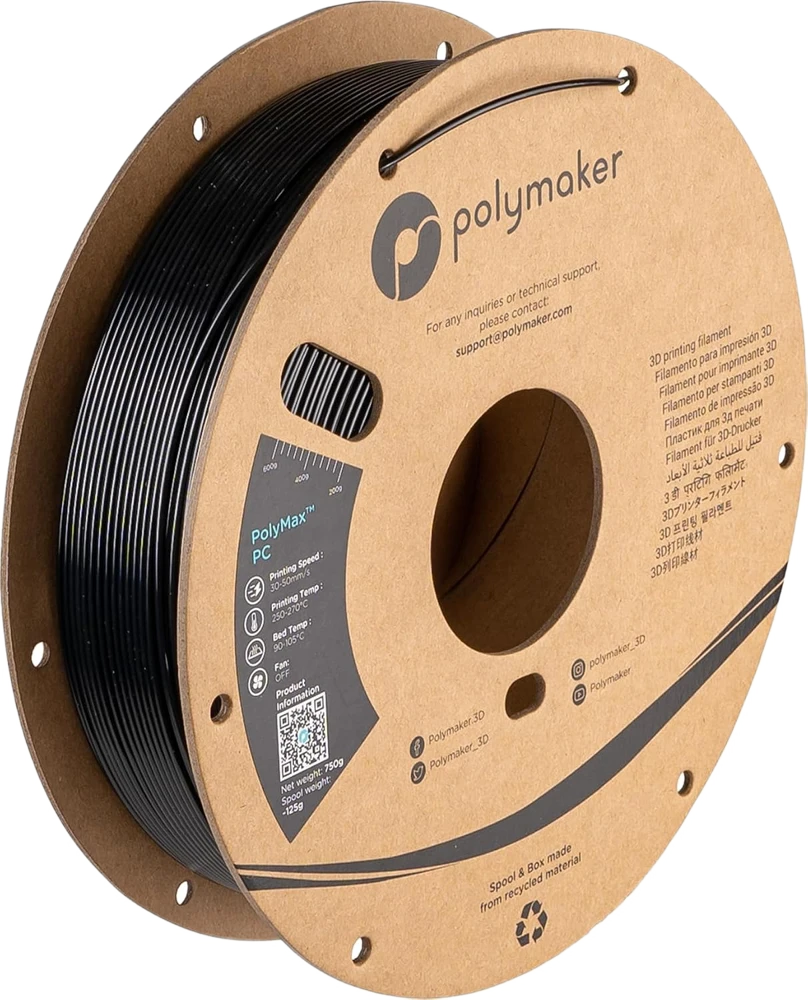
PolyMax PC