
SUNLU Easy PA review: a promising first nylon, with shrinkage still to solve
At a glance
Useful functional-print experiences support a trial; the Easy name does not remove calibration or dimensional checks.
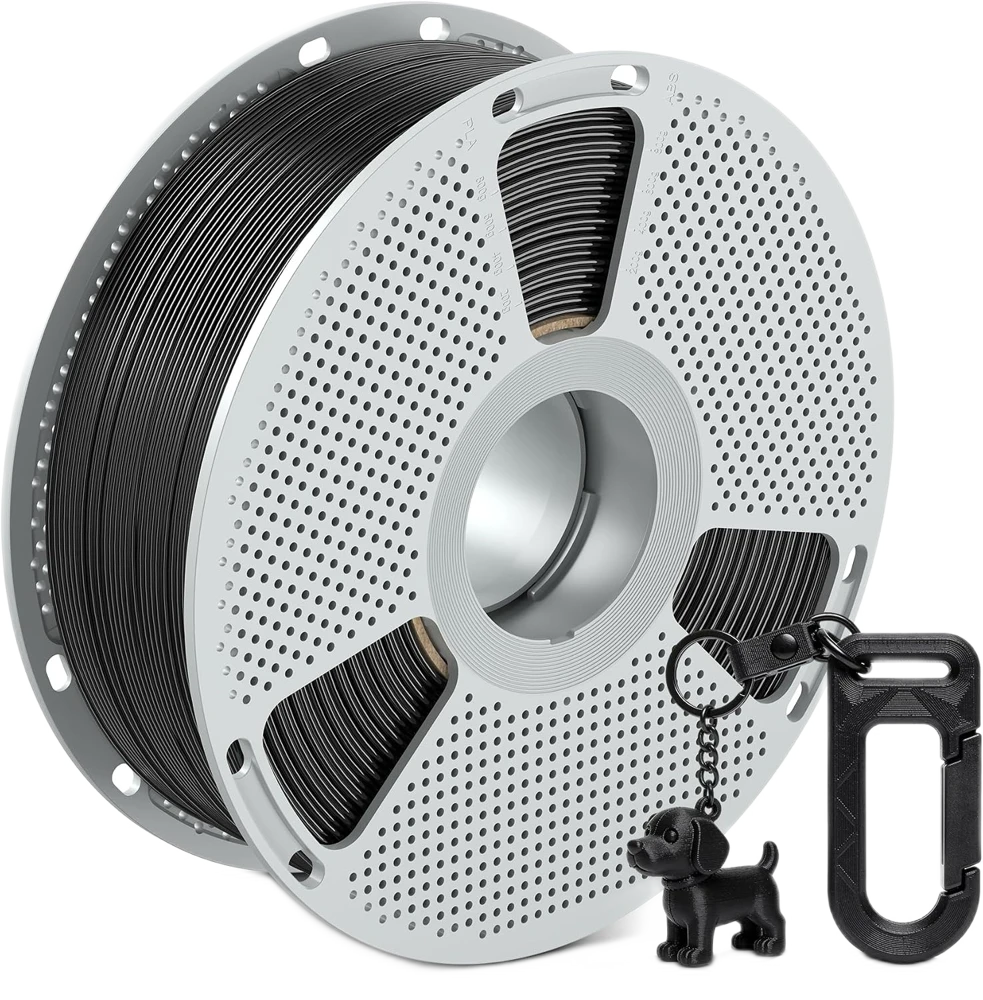
The setup
- SUNLU Easy PA nylon 6/66 copolymer according to listing
- Selected package: 1 kg spool
- Nominal diameter: 1.75 mm
Why consider it
- Approachable printing in several matched nylon workflows.
- Useful functional parts without fiber reinforcement.
What to weigh up
- Complex parts can still shrink.
- Calibration was not easy for everyone.
Easy PA is worth a look if you want to try unfilled nylon for practical parts. Matching feedback includes a first-time nylon success and useful everyday holders. The name should not be interpreted as a promise that shrinkage or calibration disappears.
Begin with the dimension that matters
If the part must fit another component, print that interface first. Successful accounts still describe compensation and shrinkage on more complex geometry. A small measured sample saves more material than discovering the mismatch at the end of a full part.
| Result | What it establishes |
|---|---|
| Clean visible surface | The extrusion and profile are promising. |
| Correct mating dimension | The chosen geometry fits at that stage. |
| Useful performance under the intended conditions | The application has passed a more relevant check than appearance alone. |
Use an Easy PA profile, not the hottest nylon setting
One matched account warns that an overly hot inherited profile worsened printing; another could not obtain a satisfactory calibration despite drying. Start from current exact-material guidance and stay within the printer’s limits.
Pros & Cons Analysis
Based on supplied customer reviews and verified product documentation
Pros
- The name has some practical support. A first-time nylon user found printing easier than expected, and other accounts describe useful hangers and holders. That supports a trial on a suitable printer.
- There is a distinct material choice here. Matching feedback describes sturdy everyday components. It does not establish a rated load or make reinforced nylon unnecessary for every design.
Cons
- Fit needs its own check. Successful accounts mention compensation or shrinkage on more complicated geometry. A visually clean print is not proof of the required dimensions.
- Keep the unsuccessful workflow in view. A detailed negative account struggled despite extensive drying. Preparation is important, but the evidence does not justify blaming every failure on moisture.
A first-nylon trial with a measured fit check
Choose Easy PA for a small functional project on a suitable printer, then measure the critical fit. Keep the full job on hold until the profile and dimensional behavior are understood.
Frequently Asked Questions
Does Easy PA mean no shrinkage?
No. Matching positive accounts still describe compensation and shrinkage on complex parts.
Is this the same as SUNLU PA6-GF?
No. Easy PA is the unfilled copolymer listing; PA6-GF is a glass-fiber-reinforced formulation.
Technical Specifications
| Product type | Nylon filament |
|---|---|
| Reviewed formulation | SUNLU Easy PA nylon 6/66 copolymer according to listing |
| Nominal filament diameter | 1.75 mm |
| Manufacturer diameter tolerance | Not verified for this exact formulation |
| Package format | 1 kg spool |
| Nozzle guidance | SUNLU TDS: 250–270°C at 50–100 mm/s; 270–280°C at 100–150 mm/s. Bed: 30–50°C on textured PEI with glue, subject to plate permission. |
| Material care | SUNLU TDS gives 80–110°C drying, without a duration. Confirm the full cycle and supplied spool limit; the upper temperature alone is not a complete procedure. |
| Variant / handling limit | Unfilled Easy PA, not PA6-GF or PA6-CF |

Fiberon PA6-CF20

Fiberon PA612-CF15

Fiberon PA6-GF25
SUNLU PA6-GF