
EIBOS Cyclopes Review: Two-Spool Drying With Awkward Reloads
At a glance
Cyclopes offers a useful two-spool drying and feeding workflow, with quiet operation in positive feedback. Lid handling, heating concerns and the move to storage after drying deserve equal weight.

The setup
- Two standard spool positions
- Fan-assisted standalone dryer
- Current specification conflict requires version checking
Why consider it
- Two-roll capacity can reduce drying swaps.
- Quiet fan operation and useful feed routing receive positive feedback.
What to weigh up
- Lid handling can make threaded spool changes awkward.
- Heating concerns and modified-unit reports limit confidence in stock behavior.
- Post-cycle storage and package completeness need attention.
Dry two rolls, then decide where they will live
Cyclopes can serve as a dryer before transferring rolls into sealed storage, or as a feeder beside the printer. The first arrangement avoids dealing with the lid while filament is threaded; the second reduces transfers but makes loading convenience more important.
| Your routine | What works in its favor | What to plan |
|---|---|---|
| Batch drying before storage | Two standard rolls can share a cycle. | Move them to suitable sealed storage after drying. |
| Printing directly from the box | Rollers and several exit positions help routing. | Lifting and closing the lid around threaded filament can be awkward. |
| Frequent color changes | The same unit can hold the active rolls. | Repeated reloads may make the enclosure frustrating. |
Heating feedback needs careful reading
Successful drying reports coexist with accounts of excessive heating and successful use only after an owner modification. Those modified results do not validate stock performance. Use the supplied configuration and guidance; if heat behavior is abnormal, stop and contact support rather than copying an unverified modification.
The current manufacturer page is also inconsistent: its main range and repeated descriptions say up to 70 °C, while a later table says 80 °C. Confirm the exact supplied version before buying for a high-temperature requirement.
Check the box before the first cycle
A falling humidity display is not a direct measurement of moisture remaining in the filament. Evaluate the material’s required treatment and subsequent print behavior.
Pros & Cons Analysis
Based on supplied customer reviews and verified product documentation
Pros
- Capacity supports a practical two-roll routine. Feedback describes drying pairs and feeding while printing. For one or two printers, that can remove repeated single-roll cycles when both materials share suitable settings.
- It can fit a working room without dominating it acoustically. Quiet operation appears alongside smooth rollers and useful exit positions. This is a subjective sound impression, not a measured noise level.
Cons
- Reloading is the recurring inconvenience. The lid has to be moved around already-threaded filament, and feedback describes cumbersome changes. Buyers who switch rolls constantly should weigh this more heavily than buyers who batch-dry and unload.
- Do not count modifications as proof of stock thermal performance. Excessive-heating concerns and pre-use spool-raising modifications appear in the original feedback. No controlled temperature map was established.
- The complete workflow extends beyond the timer. Missing support bars and conflicting support experiences warrant an inventory check. Separate feedback also describes humid air returning after a cycle, supporting transfer to suitable storage rather than indefinite protection.
A better fit for stable pairs than constant changes
Consider Cyclopes when two compatible rolls can stay loaded or move straight into separate storage. Frequent reloads and a requirement for an unambiguous higher-temperature specification weaken the case.
I want to feed while drying
Try the lid and tube route before committing the workstation. Confirm normal heating behavior using the supplied instructions.
I only want to prepare stored rolls
Plan the transfer to sealed storage after the cycle. Do not block ventilation with improvised covers during operation.
Frequently Asked Questions
Can it store filament indefinitely after the cycle?
Do not assume that. Feedback describes humidity returning after heating stops; use suitable sealed storage for longer intervals.
Should I copy the spool-raising modifications?
Unverified modifications are not a substitute for the supplied operating instructions. Stop if heating behaves abnormally and use the manufacturer support route.
Technical Specifications
| Product type | Standalone filament dryer |
|---|---|
| Reviewed configuration | EIBOS Cyclopes two-roll dryer |
| Drying capacity | Two rolls up to diameter 217 × width 80 mm each, manufacturer specification |
| Heat control | Main manufacturer guidance: up to 70 °C; later table says 80 °C—confirm supplied revision; timer: Manufacturer: 1 minute–24 hours or unlimited; verify supplied controls |
| Printing from the dryer | Supported; multiple filament exits |
| Humidity behavior | Chamber humidity readings do not directly measure water inside filament; no independently verified humidity accuracy |
| Fit and measurement basis | Check exact roller and lid clearances; no unsupported extra-roll arrangement; US 110 V version; 100 W; 213 × 280 × 305 mm |
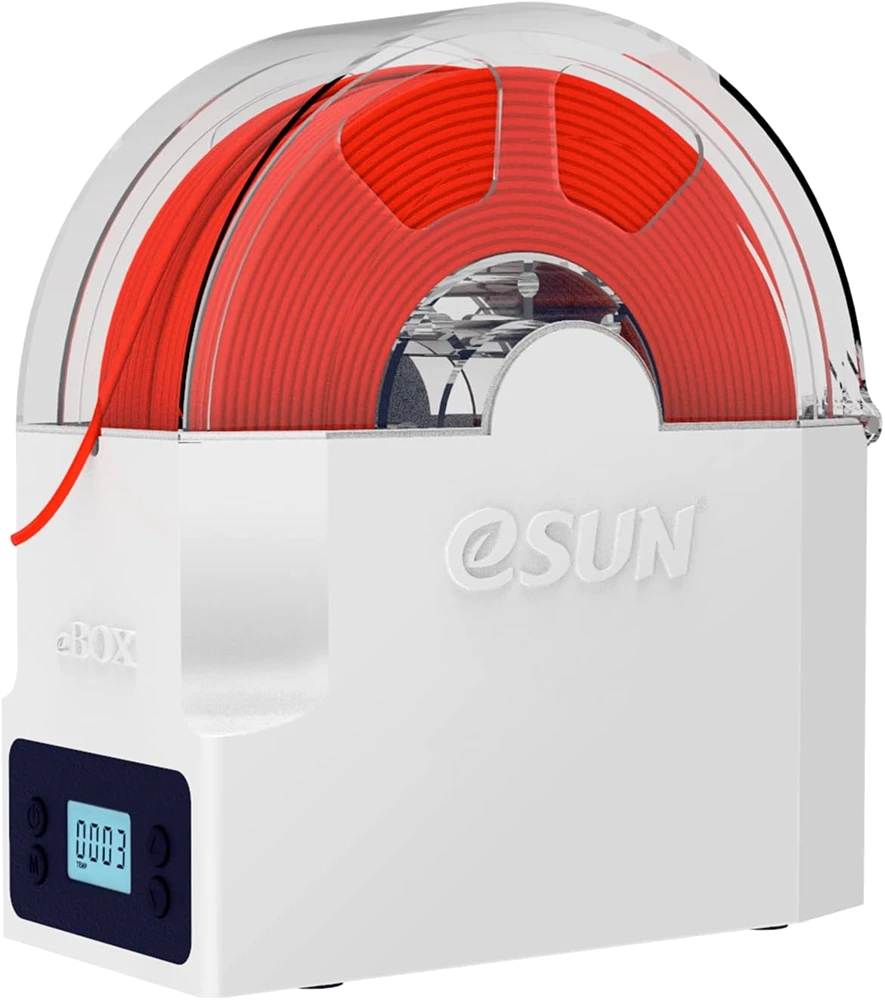
eSUN eBOX Lite

EIBOS Dyas
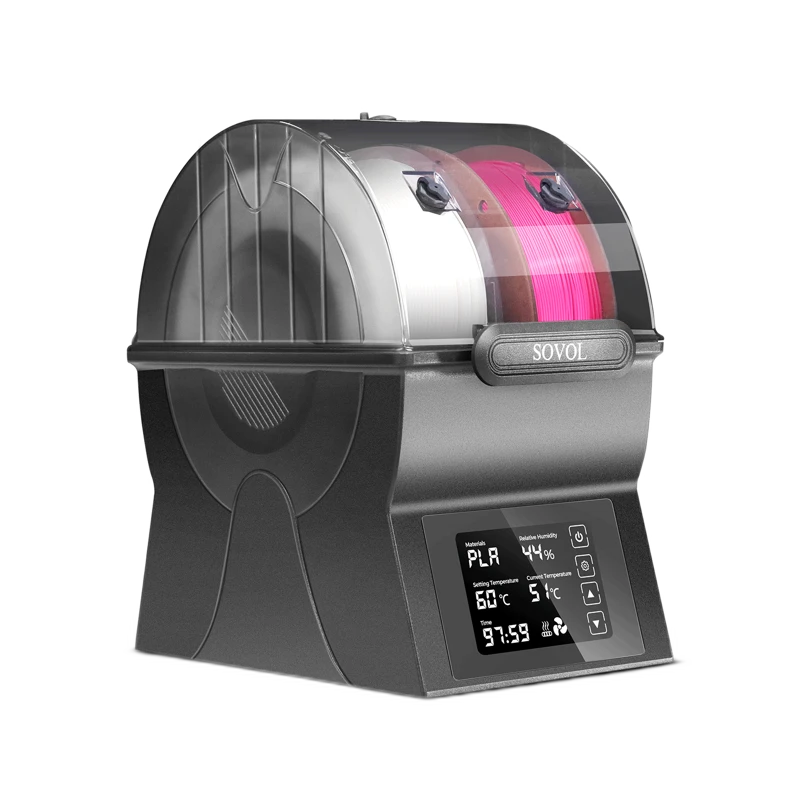
Sovol SH02
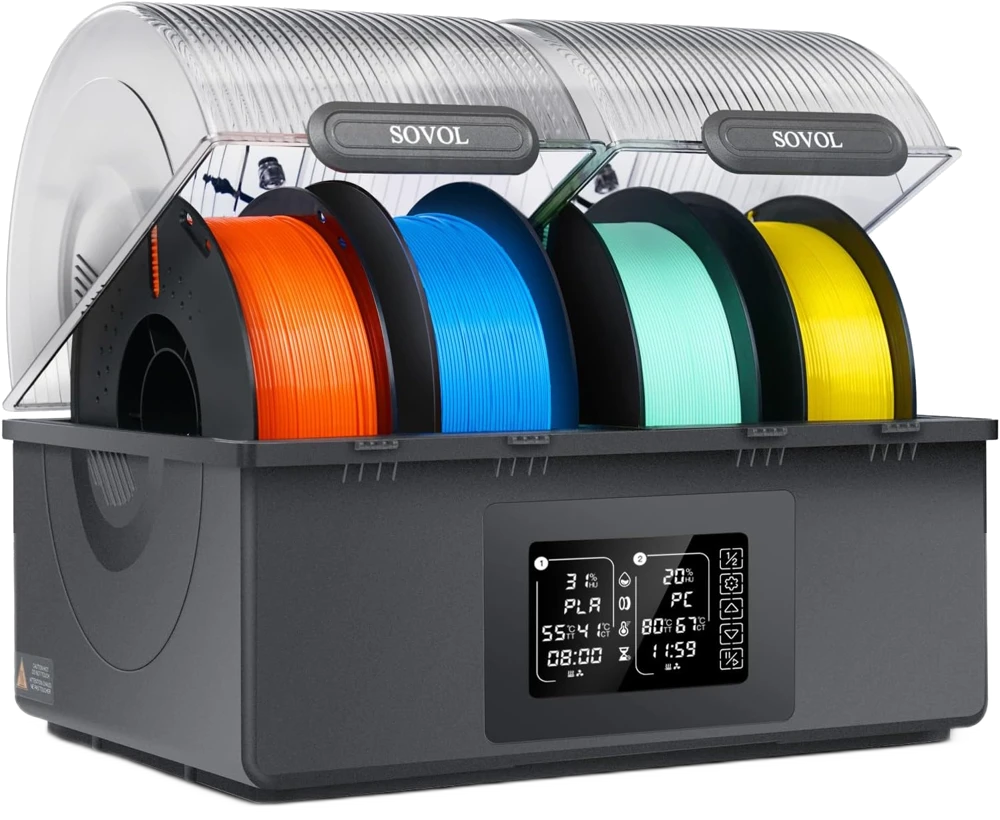
Sovol SH03